
Back in Jerusalem
Zionism in Christian Perspective, Part Three

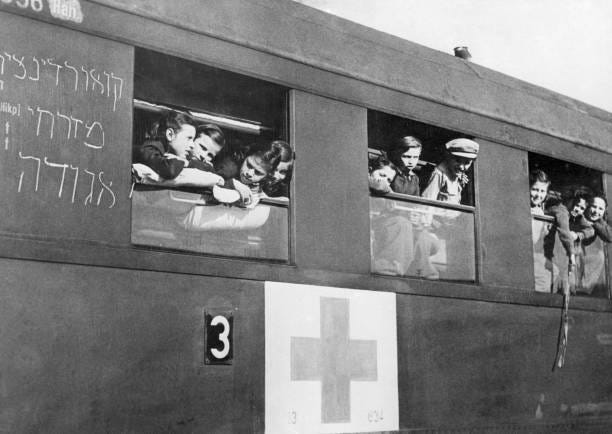
Read part one and part two.
above: Jewish orphans from Belsen en route to Israel in 1948
On the Babylonian Captivity of the Church, which came from the pen of Luther in the fateful year, AD 1520, was a frontal assault on “the Roman tyranny” and its instruments of superstition. What Augustine had called “the passing of the old rites and the institution of the new” had evolved over the centuries into something Luther found oppressive. Too many sacraments and too many sacramentals, topped off by indulgences, the new temple tax. Above all—parting from Irenaeus and the whole tradition—he objected to treating the eucharist as a sacrifice.
The authorities in Rome, he charged, were no longer proclaiming the gospel of Jesus, who had made the one sacrifice to end all sacrifices. They were only repeating the errors of the authorities in Jerusalem at the time of Jesus. They had brought the people of God back into captivity again. Luther hoped to set them straight, and when they did not come straight he turned to the Jews for support against them, thinking that an alliance of Jews and protestants might lead to fulfillment of biblical prophecies concerning the end of the age. Not finding support, he turned on the Jews also, with great ferocity.
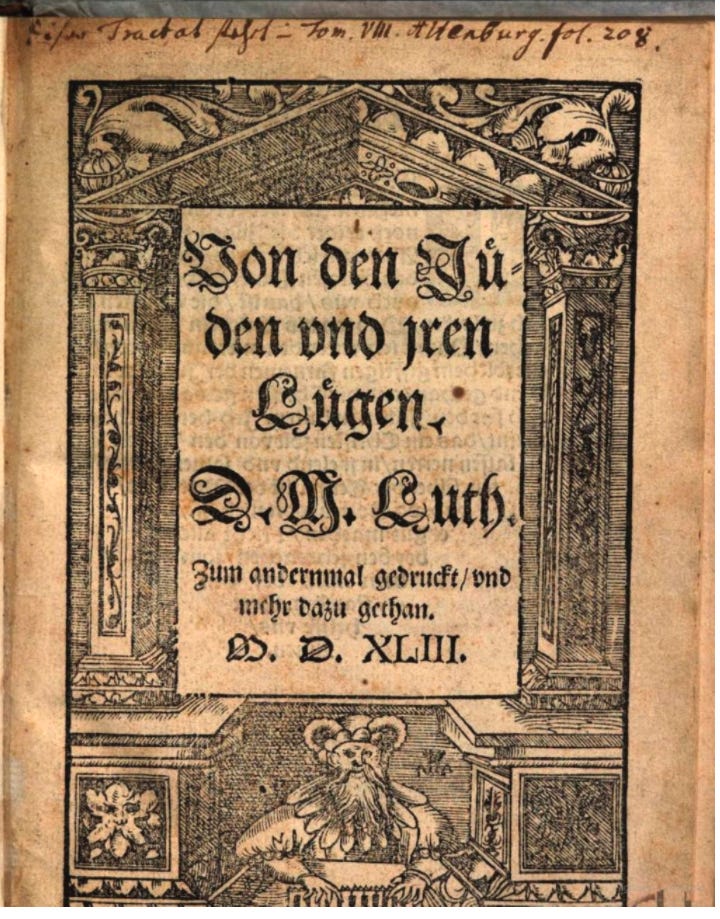
In 1543, three years before his death, Luther produced The Jews and their Lies, which carried to a new extreme the repudiation-and-replacement theology that we observed in the late mediaeval era, lending it something of the native ugliness that had made the blood libel more popular in Germany than anywhere else in Europe. “Even now,” insisted Luther of the Jews,
they cannot give up their insane raving boast that they are the chosen people of God, after they have been dispersed and rejected for 1500 years! Still they hope to get back there because of their own merits. There is no promise for that on which they could lean for comfort, except what they smear into the scriptures according to their own imagination. . . Thus the Jews at last continue in their willfulness, and knowingly want to err and not leave their rabbis, and therefore we also must leave them to their poisonous blasphemies and lies, and disregard them.
He charges the Jews with the very thing he himself is evincing and, among his countrymen and co-religionists, enabling; that is, hatred of the other.
Since childhood they have devoured such poisonous hatred against the goyim from their parents and rabbis, and still devour such without ceasing, that according to Psalm 109, it has gone over into their flesh and blood, bone and marrow, and has become their life and being. And as little as they can alter flesh and blood, bone and marrow, so little can they change such pride and envy. They just have to stay that way and be ruined, if God does not perform a special miracle.
Here we meet, in the imagination of Luther, not the Judaizing disease of which he accuses Catholics and Jews alike, but the diseased Jew as such: “Jews are young devils condemned to hell.” We hear, not the measured voice of Thomas Aquinas, ever concerned that Christians do what is right, but rather the shrill voice that incites to violence: “Moses writes in Deuteronomy that where a city practiced idolatry, it should be entirely destroyed with fire and leave nothing. If he were living today he would be the first to put fire to the Jew schools and houses.”
In Luther’s final homily, preached just a few days before his death, we find this reminder and advice:
You should know that the Jews blaspheme and violate the name of our Saviour day by day. . . For that reason, milords and men of authority, you should not tolerate but expel them. They are our public enemies and incessantly blaspheme our Lord Jesus Christ. They call our Blessed Virgin Mary a harlot and her Holy Son a bastard and to us they give the epithet of changelings and abortions. If they could kill us all, they would gladly do so: in fact, many of them murder Christians, especially those professing to be surgeons and doctors. They know how to deal with medicaments in the manner of the Italians—the Borgias and Medicis—who gave people poison which brought about their death in one hour or in a month.
Perhaps by then Luther was half-mad with the pain of his own ailments, some of which were physical, others spiritual, though there is little other evidence of that. (Rumours that he committed suicide or was himself murdered are almost certainly false.) But, Christianly speaking, this is not half mad but altogether mad. The Jew here is public enemy number one, an enemy all but irredeemable, forsaken by God and man, beyond the reach of the gospel, which is no longer, as Paul has it in Luther’s favourite epistle, “for the Jew first.” The Jew had his chance.
For its part, the Catholic Church had vacillated on the Jewish question, though it had always (and still does) read biblical prophecy as foretelling the conversion of Jews before the return of Jesus. We noted St Bernard’s intervention on their behalf. There were papal interventions also, as for example by Innocent IV, in Lachrymabilem Judaeorum (1247), or Nicholas III, in Vineam Sorec (1278), or Urban V, in Sicuti Iudaeis non debet (1365). But there were also papal interventions against them, calling for censorship and subjugation. They were ranked with pagans, heretics, and schismatics as those who, unless they repent and convert, “cannot become participants in eternal life” (Eugene IV, Cantate Domino, 1441). In A Quo Primum (1751), Benedict XIV tried to intervene both for and against while addressing a perceived crisis in Poland, though not very successfully. The same pontiff supplies evidence that ungrounded tales about Jewish murders of Christian children were still accepted as factual. In Beatus Andreas (1755), while treating questions concerning the status of children killed out of hostility to the Catholic faith, he even alludes, without questioning, to William of Norwich.
Children killed out of hostility to the faith? From the first days of Christianity to the present moment, that is a category very far from empty! It is still being filled, alas, in Asia and Africa and Europe and America. But in Germany especially, there was in the last century a coldly calculated plan to kill both parents and children out of hostility to Jews. And though it was not a plan of Christians, but rather a plan that included killing Christians after killing Jews, it was a plan that was hatched in a land where what passed for Christianity could produce a book like this one, and so also, in due course, to a book like Mein Kampf.
Now, some readers will be wanting me to say something about the putative killing of Palestinian children by the children of the children on the train pictured above. Others will want me to talk about the killing of children—their own children and Israeli children—by the beasts of Hamas. That would be more to the point, but what would it prove? The appetite for killing children, as Elizabeth Anscombe pointed out in 1968, is an ancient one. It was a feature of the paganism that brought down the wrath of God on the Canaanites. It was a feature Christianity rejected and Christendom sought to suppress. It has re-emerged with a vengeance, now that Christendom is no more, in the global abortion industry. Let us confess our own sins first! And let us also acknowledge that the Jew-hatred of late mediaeval and early reformation times contributed to the decline of Christianity and to the resurgence of this wicked appetite, as to the runaway Jew-hatred of our times, in which we take refuge from our own sins by joining the Muslim in exaggerating the sins of the Jew.
The sin we especially decry today is the sin of Zionism, objection to which we say is not racial or religious but merely political. But this is quite disingenuous. Our difficulty with the Jew long pre-existed modern Zionism. It has come to a head with Zionism because Zionism reminds us that the racial and the religious and the political cannot be so neatly divided. Worse, it reminds us that the Jew belongs to a people elect of God. It reminds us of the law of God, of which we do not wish to be reminded. The Jew was always in principle a Zionist, for he was always oriented to his rendezvous with the God of Abraham, the God who promised him the land of Canaan, the God who spoke to him through Moses at Sinai, the God who selected Zion as the dwelling place for his own Name.
What sense can it make to say that one’s objection to Zionism is strictly political?Biblically speaking, election is not merely individual but communal. Hence “Israel” is not only the name of a person but of an ethnic, geographical, political, and religious reality. Were we speaking honestly, we would not say that our objection to Zionism is merely political but rather that it is merely geographical. Even more than the Jew’s presence among us in our own lands, it is his return to Zion that bothers us, for that puts his ghetto at the centre of the world and in everyone’s line of sight.
Yet we cannot make our objection strictly political or geographical. It is also racial and especially religious. For even the Jew does not know what a Jew is, as Elias Friedman made clear in Jewish Identity, if he is not first of all someone with an inherent sense that he belongs to an elect people. He is, wherever he is and whatever else he is, a descendant of Abraham. He is an Israelite. But he is also, if secondarily, a Jew. Friedman argued that Jewishness lies at the intersection of election and torah. Being an Israelite did not and does not require torah, but being Jewish requires torah. Torah brings the religious dimension to the fore. As for being an Israeli, if he is an Israeli, that too requires torah. That is, it requires rabbinic religion based on torah—not as his own practice or as a state practice, but as a communal practice that is a sine qua non for the existence of the state, which has no reason to exist beyond the protection of the Jew in his Jewishness. And, just so, the State of Israel, secular though it be, forces religion into the limelight at the centre of the world.1
What an irony, what an irksome irony, that religion should be forced into the limelight in a secular state and in a proudly secular era, the supposedly common era, in which everyone is supposed to be assimilable! What an occasion of frustration and jealousy for all who had supposed that the Jewish religion was a curiosity of the past with no present political bearing. And how vexatious to those who suppose that Christian support for Zionism is a recent phenomenon, produced by some Jewish plot to ensnare the gullible. The truth is that modern Zionism was Christian before it was Jewish.
Zionism’s Christian Roots
The church fathers were convinced, by the same biblical prophecies that have kept Jews convinced, that God in the latter days would regather the people of Israel to the land of promise and revitalize their faith and obedience. Moreover, many believed that this, through their conversion, would prove to be of great benefit to the church and its mission. Fr Friedman is clear, as Aquinas was clear, that Jewry—that great portion of Israel that does not yet believe in Jesus—“is ordained, one day, to become an effective organ for the Church.” This Catholic expectation was shared by many protestants. While Luther’s anti-Semitic zeal, once it became clear to him that Jewry was not going to be an effective organ for his church, was not uncommon, it was matched by a contrasting philo-Semitism in other circles, especially those not given to referring prophecies about Israel directly to the church in a “spiritualizing” fashion.
The late Don Lewis, a friend in my Regent days, has amply documented in The Origins of Christian Zionism that the Zionist movement sprang from Puritan and Reformed sources in England, during the sixteenth and seventeenth centuries, where luminaries such as John Milton also took an interest in it. Notes in various editions of the popular Geneva Bible encouraged the idea that Jews should reclaim their ancient homeland and indeed must do so if biblical prophecies were to be fulfilled. By the nineteenth century, the movement had gathered considerable steam. Excitement over Jewish converts to protestant Christianity propelled it further. Both postmillennialists and premillennialists (on whom more anon) factored it into their scheme of things.
The Catholic Church had also seen converts and become enthused about seeing more of them. It was less enthused about the eschatological urgency among protestants, of which they had reason to be suspicious, though it too expected a large-scale conversion of Jews at the end of the age. When two Jewish converts—twins who were now priests in the church, Augustin and Joseph Lémann—presented their postulatum to the fathers of Vatican I, calling for an open invitation to Jews everywhere to convert, they met with near unanimous support. Only sudden prorogation of the council prevented the actual issuance of such an invitation. Denis Fahey, however, who in the mid-twentieth century was something of a champion for the kind of traditionalism that flies the banner of “Christ the King,” records a certain eschatological hesitation, if a good-humoured one:
When the Fathers Lémann were petitioning the Bishops, assembled in Rome for the Vatican Council, for their signatures to the Postulatum Pro Hebræis, many of their Lordships smilingly put the objection that “to work for the conversion of the Jews was to bring on the end of the world.” The two Fathers gave several answers to this objection, and their arguments seem to go far towards proving that there will be a considerable lapse of time between the conversion of the Jewish nation and the Last Judgment.
Unfortunately, Fahey’s book advances the anti-Semitism that one too often finds in the Christus Rex enthusiast, whose supersessionism is cast politically in integralist terms and who regards the Jew as a natural enemy; who indeed regards the Jew as a natural enemy because he regards the Jew as the epitome of those who, rejecting grace, must rely on nature. For Catholics of this persuasion, as for Luther, the Jew is now inherently diabolical and antichristic, his prophesied conversion at the end of the age notwithstanding.2
To supersessionism I will speak further, but where were we? The Puritans who came to America, and the Baptists too, brought with them the idea that Jews must reclaim their ancient homeland if biblical prophecy were to be fulfilled. They also brought with them strong anti-Catholic sentiments, supported by talk of divine blessing for nations that would look after the Jews and divine curses for those who would not. Back in Britain, Lord Shaftesbury, who became Christian Zionism’s most effective proponent, pointed to the waning of anti-Semitic Spain, for example, as an object lesson to those who despised Jews. In 1841 he and a small commission sponsored by the Church of Scotland published in London’s Colonial Times their “Memorandum to Protestant Monarchs of Europe for the restoration of the Jews to Palestine,” calling for the marriage of “a people without a land” to “a land without a people.”
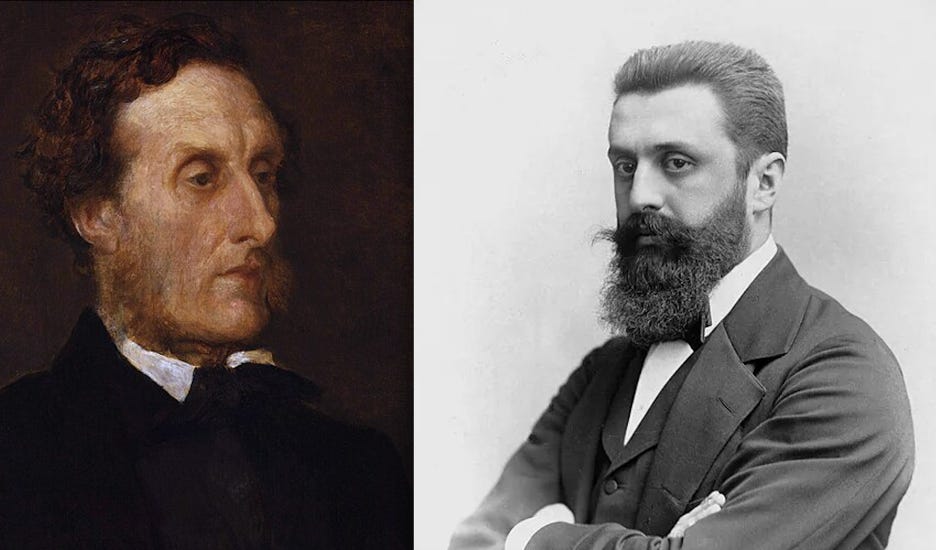
Lord Shaftesbury, founder of the London Society for Promoting Christianity Among the Jews, and Theodore Herzl
A non-theological vision, less utopian in character, took shape shortly afterwards in the mind of Theodor Herzl, who was appalled by the false conviction of Captain Alfred Dreyfus for treason as French anti-Semitism (sanctioned by local Jesuits) came to a boil towards the turn of the twentieth century. Herzl saw the need for a Jewish refuge and became the founder of a secular Zionist movement. He is widely regarded as the father of the State of Israel, though he didn’t live to see it established. In Der Judenstaat (1896) he laid out a programme for it: re-establishment of Jewish sovereignty in Palestine; the gathering of the exiles; and the liberation of Jewry from systematic discrimination and persecution.
Many establishment or assimilationist Jews opposed him, and some religious Jews charged him with playing God. We must wait for the messiah, they said, before attempting such a thing. Others, however, having some premonition of what was to come in Europe, supported Herzl. In subsequent decades Jewish Zionists laboured by means moral and immoral, including what can only be called terrorism, to re-colonize the land some refer to as Palestine and others as Israel, and to create a state for Jews centred on Jerusalem.
Along the way there were arguments about means, as there still are today, including the role of violence or terror, of which the Irgun approved and the Yishuv (like the World Zionist Organization) did not. There were arguments as well as to whether Zionism should be a political exercise only or also an ethnic and cultural one. As Ahad Ha’am put it, the goal should be “a Jewish state and not merely a state of Jews.” He had in mind a Hebrew-speaking territorial centre for a revitalized Jewish identity in the modern world that was philosophically and ethically integrated with the best of secular European culture. Synthetic Zionism was the label given it. Respect for the old religion was requisite, but the enterprise itself was to be secular and “spiritual,” not religious. Religious Jews saw it as a threat, not a promise. Baruch Kurzweil, notes Friedman, went so far as to characterize it as a “quiet demonism.”3
Internal as well as external opposition to either option was fierce. The Vatican, which remained wary of states founded or re-founded on beliefs incompatible with confession of the divinity and lordship of Jesus, refused its support. Pius X did not oppose Jewish settlements in principle, but did tell Herzl, in a brief private audience in 1904, that the Church could never approve a Jewish state, on the grounds that the land belonged now to Christ the King. It was, in that sense, still a Jewish patrimony, but not the patrimony of Jews who denied Jesus.
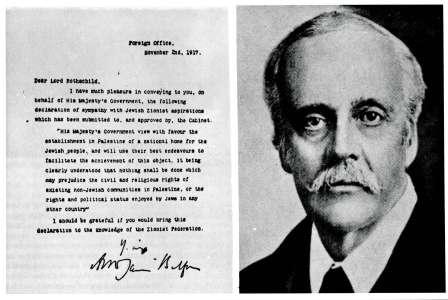
World War I dramatically changed the political landscape, putting an end to the Ottoman Empire and yielding the British Mandate. Already in 1917, the Balfour Declaration announced Britain’s support for “the establishment in Palestine of a national home for the Jewish people . . ., it being clearly understood that nothing shall be done which may prejudice the civil and religious rights of existing non-Jewish communities in Palestine.” (Such things would be done, of course.) While preparations for that were still being made, Hitler burst onto the scene, intent on reviving the war. His millennial vision for a Third Reich required expansion of Lebensraum for Aryans. Space for Jews, however, contracted to a vanishing point in the ovens of Auschwitz and other extermination camps.
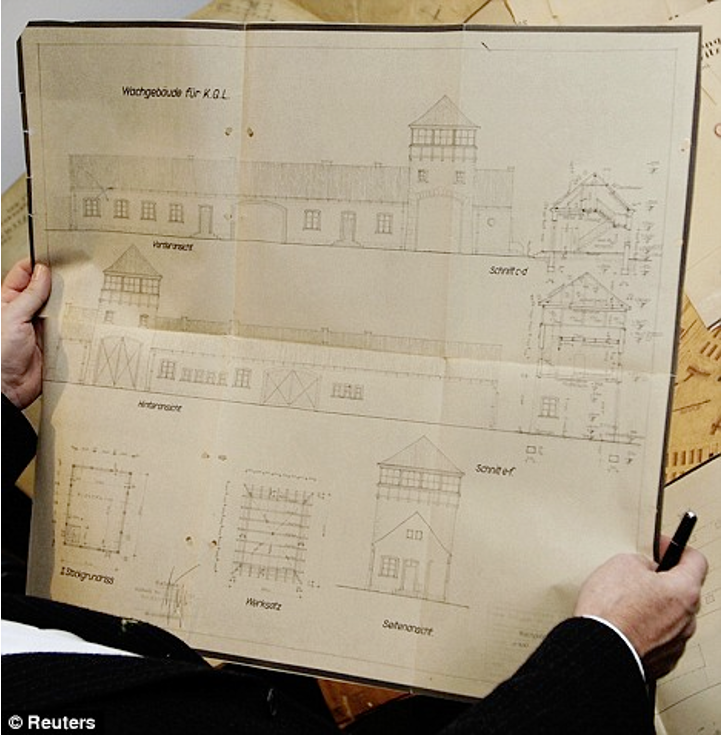
Auschwitz blueprint, 23 October 1941, discovered in November 2008
Pius X died as the Great War began. During the second war, the Vatican under Pius XII—he who was falsely accused of submission to the Nazis and of enmity to Jews—changed its approach. It began working in support of the German resistance and providing assistance to Jews, whose need for protection in Europe and for a homeland of their own had become undeniable.
Small bands of Jewish settlers had been tilling arable land in Palestine for at least a century, following much older precedent. The persecution of Jews in Russia in 1881 resulted in many additional settlers. When Nazi atrocities were laid bare after the war, events moved very quickly. The foundations for a new state, including its financing and provisions for its defence, had already been arranged by visionaries and wealthy benefactors. In 1948, just as the British Mandate expired, David Ben Gurion announced to the world the creation of that state.
Arab objections notwithstanding, nor the fact that the soil of the nations was still soggy with anti-Semitism, the State of Israel was received into the United Nations in 1949. Hadrian’s ban on Jews in the vicinity of Jerusalem was at last being overturned. In 1980 the Jerusalem Law made that city the nation’s capital, though it was 2017 before America recognized it as such. Meanwhile wars of conquest were fought against the fledgling state, but they succeeded only in expanding the territory under its sway. What seemed like miracles had again taken place. The words of ancient prophet were coming to life.
The nation of Israel is today some ten million in population and the most advanced, as well as the most democratic, of all the nations in the region, if also the most vilified. The present measure of its vilification is the support garnered by Hamas for the atrocities of 7–8 October 2023. That there have been sporadic Israeli atrocities over the course of the last century no one denies; the violence that persists today, in Gaza and the West Bank, many Israelis themselves lament. But the violence directed towards them, not only by Hamas and Hezbollah, but from individuals and organizations around the globe, is unparalleled. The spirit of Apion or of Luther seems to animate millions, though they know little or nothing of either. That anti-Zionist crimes are celebrated by so many, while Zionist crimes, real or imagined, are endlessly vituperated, speaks volumes about our collective moral condition.
It goes without saying that neither Jews nor Christians are of one mind about Zionism. There are important differences even among those who support it. Catholics are quite divided, as a look at the new Catholic Voices for Israel site makes plain. While I cannot engage here with all that, I can attempt to explain in my own way a few of the differences that matter theologically. I will do that under two headings, the first being ecclesiological (having to do with the church) and the second eschatological (having to do with the end of the age).
The topic of the first is supersessionism; that is, the idea that the church supersedes Israel as heir to the promises originally made to Israel. The topic of the second is millennialism; that is, expectation of a long age of peace under the reign of the messiah. These two ideas intersect both in Zionism and in anti-Zionism. Only when we have a map of them in front of us will we be in a position to say something about the kind of support that can, or cannot, be lent to Zionism. I will try to keep the map as little cluttered as possible, for the sake of the reader to whom this territory is unfamiliar.4
Supersessionism and Anti-supersessionism
On 1 May 1897, Civiltà Cattolica responded skeptically to the calling of the First Zionist Congress, remarking inter alia that, “as for a rebuilt Jerusalem, which could become the centre of a reconstituted state of Israel, we must add that this is contrary to the prediction of Christ himself.”
This rebuilding and centring, however, is exactly what happened. So was Jesus a false prophet, or were those who thought like this mistaken in their understanding of Jesus and of church doctrine? The latter, obviously. And why? Because they were working with a faulty understanding of the sense in which the church can be said to supersede Israel as heir to the promises.
Supersessionism comes in two basic forms, though these are variously labeled. What I have elsewhere called hard and soft supersessionism I will here call closed and open, referencing their capacity or incapacity to accommodate Zionism.
Closed: The old covenant through Moses is abrogated by the new covenant in Jesus Christ, which replaces it. The church therefore replaces Israel as the people of God. The consequences for Jews who do not enter the church can be viewed in two ways, both harsh but one harsher: (1) They have been entirely disinherited and left to wander the earth. They remain a people ethnically, but not spiritually. Their religion is now in vain, if not antichristic, and no promises concerning the land pertain to them. (2) They have not merely been disinherited but made over into an object of wrath; their perpetual suffering is a sign to everyone of the possibility and consequences of reprobation. They deserve to be shunned and otherwise punished by man, as by God, for, unless individually they convert and leave their old ways behind, they carry the guilt of deicide.5 On either view, we are talking about repudiation and replacement. Once the Jews were the people of God and heirs of the promises; now they are not.
Open: The church is not a new Israel but rather Israel renewed. It is the righteous remnant of Israel, expanded by inheriting the faithful out of every nation. The new covenant it enjoys is genuinely new, for its mediator is new: the Mosaic has given way to the messianic. This new covenant is still the original Abrahamic covenant, however, and it is still for Abraham’s descendants, though also for the gentiles—all who die and rise in baptismal unity with Jesus are its beneficiaries. The original people of the covenant and the old form of the covenant are not repudiated and replaced, then, but fulfilled and surpassed. Just as in the resurrection what is mortal is not repudiated and replaced, but transformed and rendered immortal, so with the covenant itself. The Mosaic did not fulfill and surpass the Abrahamic, but only augmented it. The messianic transforms it, making the augmentation obsolete.
Here again the implications for Jews who reject the proclamation of Jesus as the messiah, and do not avail themselves of his mediation, can be viewed in two ways. I will explain that in a moment, but first a remark on mediation. The Abrahamic covenant always awaited the mediation of Christ, for Abraham was merely its beneficiary, not its mediator. He, the human partner to it, arranged the requisite sacrificial materials for its ratification and defended them from the birds of prey, which signify all that stands in opposition to the covenant. But HaShem, the divine partner, passed alone between the two halves of the sacrifice, manifesting his presence with flaming firepot and smoking torch. Precisely because Abraham was not the covenant’s mediator, he himself required the blessing of a mediator—of Melchizedek, that mysterious messianic “type” who ruled Salem as prophet, priest, and king. The mediations of subsequent prophets or priests or kings, including Moses, Aaron, and David, were never more than provisional. They were mediations according to sign, not reality, until the messiah should come.
Approached thus, what are the two ways of viewing the portion of Israel that does not accept that Jesus is the messiah or admit that the messianic has arrived? What is their situation if, as the author of Hebrews says in exposition of Jeremiah 31, “in speaking of a new covenant he treats the first [that is, the Mosaic] as obsolete”? What is their situation if “what is becoming obsolete and growing old is ready to vanish away”?
The first way is to see the Mosaic form of the covenant as having completed its service within the divine economy. Its stipulations have been faithfully fulfilled. Its curses for covenant-breaking have been shouldered by Jesus on the cross. Its blessings have been obtained by Jesus in his resurrection. Because he, through death, has been released from its requirements, and yet lives, the old law no longer binds him or those united to him. It has lost its force and is ready to vanish away. Those who still look to it find no proper covenantal form of life because they are looking to what is obsolete. They still have tanakh, that portion of the scriptures they share with Christians. They still have their oral tradition as recorded in talmud, with its mishnaic and gemaric fragments, like twelve baskets of manna gathered in their desert wanderings. But these fragments do not keep like the scriptures keep, and they do not bind as the scriptures bind. They do not have the authority or support of prophets, priests, or kings, an authority that has passed to God’s Christ.
Now, some find this view, which they label “economic obsolescence,” difficult to distinguish from closed supersessionism, though it is distinguishable. For here the Jew outside the church is not going altogether hungry, or need not. Nor is he repudiated and replaced by those inside the church, the bulk of whom are gentiles. Neither has the covenant on which he relies been repudiated, though the form he is trying to follow has been made obsolete. The Israelite who is a Jew rather than a Christian, because he tries to live according to the teachings of the rabbis rather than according to the commandments of Jesus, is not in his own person obsolete.6 He is still the object of divine election and of the divine invitation. Birds of prey have long hovered over him, as if he were cursed, but father Abraham is still protecting him with his intercessions, that the fullness from his own offspring may be added to the fullness from the nations in the one household of God.
The second way is this: The Mosaic form of the covenant having been discontinued with the advance of the economy of salvation, and certain of its essential components no longer being available to the Israelite who remains outside the church—I mean the temple and priesthood and sacrificial system, which inside are available in their new messianic form—the remaining components nonetheless suffice to maintain a covenantal form of life proper to an exilic Jew. Those who hold fast to what they have, if they do so through what the church calls “invincible ignorance” rather than out of rebellion against God and his Christ,7 are lacking many benefits that God intended the covenant to provide; but they do not lack all possibility of faith and faithfulness or the covenantal guarantees, because God has made good on all that, vicariously, in Christ. What they currently lack they may eventually receive, though not in quite the fashion they imagine; for they remain “the sons of the prophets and of the covenant which God gave to [their] fathers, saying to Abraham, ‘And in your posterity shall all the families of the earth be blessed.’”
While these two are not incompatible, the second allows for what the first does not; namely, that the Jewish way of life—where it is not predicated on a culpable denial of Jesus—remains covenantal in character and should be treated as such. Neither pretends that a culpable denial is without severe consequence, as it was in the days when, at Kadesh Barnea, the people refused to go into the land of promise, the days in which Korah and his collaborators denied the authority of the one whom God had placed over them, the days in which “the people of Israel said to Moses, ‘Behold, we perish, we are undone, we are all undone.’” Nor does the second fail to acknowledge that unpicking the knot of the vincible and the invincible, the culpable and the non-culpable, is often next to impossible for man. It does allow, as we must allow, that it is perfectly possible for God. And it has the advantage of not trying to decide for God how quickly something that has been rendered obsolete must vanish away. Hebrews warns the Israelite who is now a Christian against turning back; that is, against apostasy. It does not warn the Israelite who is still a Jew that he is nothing at all.
Anti-supersessionism is an awkward category, for it must include both the open supersessionist who is against the closed and the closed who is against the open. The open may be quite definite in describing himself as an anti-supersessionist. He does not usually mean, however, what I mean here. As I am using it, the label fits those who regard the covenant inaugurated by Jesus either as a more perfect expression of the covenant under Moses or as a new and complementary covenant for gentiles. Neither thinks the Mosaic covenant abrogated or obsolete; both think new provisions have been made for gentiles. The first option is that of the “messianic Jew” who tries to adhere both to rabbinic and to Christian essentials, but finds himself all by himself, doing what no one else does. The second option is more common. It posits Jews and Christians as two distinct peoples of God, each with its own covenantal obligations. This “dual covenant” theology has Jewish and Christian versions.
Both these forms of anti-supersessionism are rejected by the Catholic Church. The first is vague about the divinity of Jesus and about authority in the church. The second calls into question his universal lordship, the necessity of his mediation, and the unity of the divine economy. Both allow for Zionism, but that fact alone can neither condemn nor redeem them.
As for what we are calling closed supersessionism, though it was popular in the church for a time, it has been repented of and repudiated. The church itself is anti-supersessionist in that sense, though some within it still speak as if the very idea of tradition would fail were this repudiation to stand—a concern that looms large in their doubts about Vatican II, which charted a new course for relations between Christians and Jews. Rejecting the council, like abusing the council, does not leave tradition intact, however; quite the reverse. What is worse, closed supersessionism sets the New Testament against the Old, in Marcionite fashion, and God against God.
That leaves us only with open supersessionism as a viable option. We may sympathize with those who seek a more palatable label for it, lest it be associated with closed supersessionism. We must not be hasty, however, lest we lose the substance while fixing the nomenclature. If Jesus supersedes Moses, the new covenant supersedes the old in its Mosaic form, and the eucharistic life of the church the life of the synagogue whence it sprang. Did the author of Hebrews not make this clear enough?
Therefore, holy brethren, who share in a heavenly call, consider Jesus, the apostle and high priest of our confession. He was faithful to him who appointed him, just as Moses also was faithful in God’s house. Yet Jesus has been counted worthy of as much more glory than Moses as the builder of a house has more honour than the house. (For every house is built by some one, but the builder of all things is God.) Now Moses was faithful in all God’s house as a servant, to testify to the things that were to be spoken later, but Christ was faithful over God’s house as a son. And we are his house if we hold fast our confidence and pride in our hope.
God’s purpose was unchangeable in character, argues Hebrews, but not the arrangements he had made for his people, for the law of Moses was “but a shadow of the good things to come.” Sinai was covered in shadow when the law was given. Darkness and gloom prevailed over Jerusalem from the sixth to the ninth hour, while Jesus hung on his cross. The good things to come were inaugurated by his resurrection and glorious ascension. Those who share in them, sacramentally, are brought “to Mount Zion and to the city of the living God, the heavenly Jerusalem, and to innumerable angels in festal gathering.” They are brought to the very threshold of the world to come, the world alight with glory.
This produces a change in worship, the old being abolished that the new may come; among those who wait for their Lord’s return from the heavenly Holy of Holies, “newer rites of grace prevail,” as Thomas puts it in his hymn Pange lingua. It effects change in the mission also, for glad tidings of the new Melchizedek go out to every nation; whosoever wills may be joined to his priestly kingdom. It effects change in the way scripture is read; new meanings burst forth in the light of that kingdom. But what of the old promises? Are they abolished? Does their literal sense evaporate? Not on the view we are now considering.
Confidence and Caution
One principle that must be kept in view, if one intends to follow the prophets and apostles rather than the Marcionites and gnostics: Redemption does not overturn creation. As Jeremiah 31 makes plain in announcing the new covenant, it restores and perfects it. Therefore the literal sense remains, though new light is cast upon it.
Thus says the LORD,
who gives the sun for light by day
and the fixed order of the moon and the stars for light by night,
who stirs up the sea so that its waves roar—
the LORD of hosts is his name:
“If this fixed order departs
from before me, says the LORD,
then shall the descendants of Israel cease
from being a nation before me for ever.”
The fixed order does not depart, nor shall they cease. “Descendants of Israel” does not reference a spiritual reality only, any more than the new creation is a spiritual creation only. Israel will not be submerged forever in the sea of nations.
When Hebrews repeats the promise of Jeremiah, adding that what does not belong to the fixed order must be “shaken out” of it, there is no suggestion that the houses of Israel and Judah are shaken out, or God’s covenant with them. Its author does not dispute what the prophet had said:
There shall be a day when watchmen will call
in the hill country of Ephraim:
‘Arise, and let us go up to Zion,
to the LORD our God.’For thus says the LORD:
“Sing aloud with gladness for Jacob,
and raise shouts for the chief of the nations;
proclaim, give praise, and say,
‘The LORD has saved his people,
the remnant of Israel.’”
The promise of the land also remains, then. It is no accident that Jeremiah, when speaking of the new covenant, comes back to the land and to the Jerusalem below:
“Behold, the days are coming,” says the LORD, “when the city shall be rebuilt for the LORD from the tower of Hananel to the Corner Gate. And the measuring line shall go out farther, straight to the hill Gareb, and shall then turn to Goah. The whole valley of the dead bodies and the ashes, and all the fields as far as the brook Kidron, to the corner of the Horse Gate toward the east, shall be sacred to the LORD. It shall not be uprooted or overthrown any more for ever.”
All that being said, something else must be said as well. For Hebrews situates the remnant of Israel differently in relation to the land, as to all the promises. Are they followers of Jesus? Let them bear in mind that Jesus “suffered outside the gate in order to sanctify the people through his own blood. Therefore let us go forth to him outside the camp, bearing abuse for him. For here [ὧδε] we have no lasting city, but we seek the city which is to come.”
It should be noted that ὧδε is adverbial. Its primary sense is not “here as opposed to there,” but rather “as things are now.” And how are things now? This is still a time of shaking, as at Sinai and Zion. False ways, false ambitions, false hopes—these must be shaken out so that “what cannot be shaken may remain.” What remains is what God has guaranteed. “So let us hold fast the confession of our hope without wavering, for he who promised is faithful.”
What then shall we say about the land in this time of shaking? That even the Israelite who is a follower of Jesus should disregard the promise of the land until Jesus comes? Non sequitur. The question of the land remains pertinent. God contends with the nations through the gospel that his church carries to the ends of the earth, but that does not mean that he does not contend with them also by keeping the land in play. God contends with the Jews through that same gospel, but that does not mean that he is not behind their regathering to the land. The Christian must exercise caution regarding the claims of both Jew and gentile where the land is concerned. It is only the claim of God that matters. Yet the Christian must recognize that God has claimed it and does claim it, and that he has promised it to the descendants of Abraham.
“Remember Jesus Christ, risen from the dead, descended from David, as preached in my gospel.” That was Paul’s advice to Timothy, and so also to us. The closed supersessionist seems to have forgotten that Jesus is descended from David, of the tribe of Judah, the tribe for which all Jews are named. He wants to shake off everything Jewish, everything “carnal,” including concern with the land. So he spiritualizes everything, including even “the city which is to come.” He speaks as if the old covenant with Israel had failed, not realizing that its failure would imply the failure of both parties to it, not one only. Indeed, it would imply the failure of Jesus the mediator between them, who wrestled with God and man and was victorious because he is both God and man.
When man is faithless, does God not remain faithful? God chose the Jews, not because they were numerous and strong, but because in their weakness he would display his glory through them. He has not succeeded and so has cursed the Jew qua Jew? He has cursed Jacob with an irrevocable curse, rather than blessing—and burdening—him with an irrevocable calling? God forbid! That sort of theology is utterly lacking the spirit of Pentecost. It is opposed to the Holy Spirit. And there is no way out of it by speaking of the redemption of the Jew as an individual only. That is merely to add the philosophical error of nominalism to the theological error of closed supersessionism—the supersessionism that posits a weak, conflicted, angry God, a God who is nothing but a projection of man’s fallen self and a justification of his hatred of his neighbour, the Jew.
The anti-supersessionist, on the other hand, has forgotten that David “both died and was buried, and his tomb is with us to this day;” that God “has set one of his descendants upon his throne,” apart from whom the promises made to Israel cannot be fulfilled. The anti-supersessionist wants to find a way to make them come true without insisting on the lordship of Jesus or relying on his mediation. He wants peace and stability, not shaking or the sword, but it eludes him. He wants harmony between covenant peoples, but that too eludes him.
By reason of their forgetfulness, then, both err in the matter of Zionism, the latter by fixating on the land and the former by denying any relevance to the land. The anti-supersessionist looks for a kingdom attained by re-conquest of Judaea. The closed supersessionist looks for a kingdom attained by the conquest of every land, such that all peoples become subservient to the church. Each has retained a moment of truth; both indulge a deceptive, dangerously over-realized, eschatology.
In his conflation of church and kingdom, the closed supersessionist has Christ reigning invisibly in heaven and the pope reigning visibly on earth. The saeculum is seen as a theatre for the display of God’s glory through the advance of the church as a worldly power. Trouble there may be, yes, and has been for half a millennium. The wine of the kingdom seems to be running low even in the church. But Mary, he says, will see that it is replenished and that the church will triumph over the world. On this approach, the return of Israelites to the land, not as Christians but merely as Jews, is viewed as a setback, a sign of contradiction, a discrediting—as if Julian the Apostate were having the last laugh. It must therefore be opposed.
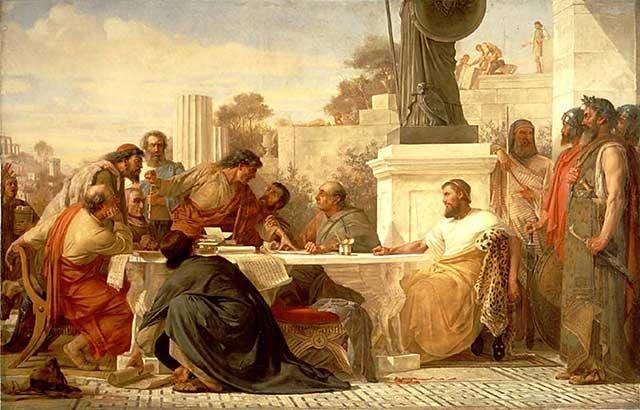
Armitage: Julian the Apostate presiding at a conference of sectarians
#/media/File:Edward_Armitage_-_Julian_the_Apostate_presiding_at_a_conference_of_sectarian_-_1875.jpg)
The anti-supersessionist, for his part, sees the re-establishment of a sovereign Jewish state as a sure sign that the kingdom is at hand. It must therefore be supported. But is it really a sure sign? When was there last a sovereign state? On what was its sovereignty predicated? What became of it? There is eschatological confusion on both sides. We will pursue this further in part four, taking millennial constructs into account.
Jewish Identity, though published fifty years ago, remains essential reading despite the fact that this notion of a “Jew” is still disputed. The dispute itself underscores the point I am making, which is that, if one cannot neatly divide up the fourfold idea of “Israel” with which we began in part one, neither can one claim convincingly that one’s anti-Zionism is merely political and not racial or religious. But let me try to clarify a bit further the notion in question. To be a member of the people who, in and with Abraham, were the immediate object of divine election, is to be an Israelite. The Israelite is a “Jew” only by virtue of “being placed in relation to the law of Moses;” that is, to the practice of Judaism. This relation may be external to the Israelite as such, but it is internal to the existence of Jewry; hence also to the existence of a Jewish state. For the purposes of that state, even an atheistic Israelite is considered a Jew, enjoying a right of return and the attendant benefits, because in principle he can be connected to the practice of Judaism. But anyone who has converted to a non-rabbinic religious practice (dat) is not so considered. Though neither has chosen the path of subjection to torah, only the latter—while remaining a Hebrew, an Israelite—has ceased to be a Jew in either rabbinic or state terms. That was Fr Friedman’s own situation after he converted and became a Carmelite. The book’s introduction contains a brief account of his truly remarkable life; the book itself contains a sophisticated account of his anti-revocationist theology, in the spirit of Romans 9–11.
The Jew, for them, is Jezebel, though Jezebel was not a Jew. Fahey’s book (1953), which like other literature of its type I think insidious, can be found here, imprimatur and all. (“All,” at chap. 8 n.5, includes holocaust denial.) A far better source for consideration of Jews and Judaism in relation to the church is Roy Schoeman’s Salvation is from the Jews (2003). For a different take than Fahey’s on the theme of Christ the King, see my essay by that title.
Friedman, Jewish Identity (1987), 37. Friedman, who remarks that Ahad-Ha’amism “infused a secular soul into the political framework of the Zionist movement” (p. 29), also notes Justice Silberg’s opinion “that Synthetic Zionism was the prevailing ideology of the State of Israel.”
The well-travelled reader, who is looking for more, will find more on the first topic in chapter eight of Theological Negotiations, a book in which he will also find a more generous treatment of Luther, albeit on another subject. On the second topic, he will find more in my commentary on 1 & 2 Thessalonians, albeit (as my late friend, Robert Wilken, delicately described its intertextuality) “with what may appear to some as reckless abandon.” The reader who himself suffers from reckless abandon might go so far as to purchase one of those books.
Kendall Soulen’s label for this is “punitive supersessionism.” In “Israel’s Eschatological Destiny in the Catholic Interpretation of the Prophets” (2016), André Villeneuve traces it to Origen’s Contra Celsus, something I failed to mention in part two. Origen at 4.22: “And we say with confidence that they [the Jews] will never be restored to their former condition. For they committed a crime of the most unhallowed kind, in conspiring against the Saviour of the human race.” (ANF 4:506). And at 2.8: “After the advent of Jesus the Jews were altogether abandoned, and possess now none of what were considered their ancient glories, so that there is no indication of any Divinity abiding amongst them” (ANF 4:433). Villeneuve, unfortunately, tars all forms of supersessionism with this brush. Denis Fahey, to whom a good deal of that tar surely sticks, nonetheless follows the Lémann brothers in quoting Origen to quite different effect, from the latter’s fourth homily on Jeremiah: “Israel’s failure to correspond has been the occasion of the calling of the Gentiles. We have taken their place and thus have become the true Kingdom of Judah. But our last times will resemble those of the Jews because of our sins; in fact they will be worse.”
“The Israelite who is a Jew rather than a Christian”: see again n. 1 in explanation of my use of this formula, which distinguishes between Israelite and Jew rather than between the Jew who is not a Christian and the Jew who is a Christian. The latter distinction is perfectly biblical, however, and I shall continue to use it, though the Jew today has difficulty making sense of it. Paul, for example, alluding to the temple precincts, insists that in Christ there is no wall of separation between “Jew and Greek.”
On invincible ignorance, see Gavin D’Costa, who argues an approach similar to the one just outlined, proposing that it has the merit of being compatible with Cantate Domino (despite the rather harsh supersessionism of the latter) and that it is able to make better sense of Paul’s own approach in Romans, as of the recent reappearance of Hebrew Catholics. I am sympathetic, with some reservations. Among them is a doubt about the proposal to see in the present situation, and in those who regard themselves as Hebrew Catholics, a reconstitution of the time of transition that marked the early church. Another is the use of “fulfillment thesis” as a label for views of the open supersessionist type, for “fulfillment” is attached to too many variants, some of them conflicting. (When I used it myself in part two, I was careful to pair it with “remnant” theology, so that the focus would remain on the church from Jews and gentiles; a purely gentile church has never existed nor could exist. Here I will pair it with “transformation,” lest its newness be underestimated.) A third reservation is that we not suppose it meritorious to seek compatibility with a papal bull on all points, the gift of infallibility not being evenly distributed among them or within them.
A reader reminds me of Benedict XVI's observation that “His blood be upon us and upon our children” can be seen as an invocation of divine protection, like blood on the lintels in Egypt. Which it can—by God's intention, not man's. What a marvelous thing, divine grace!
When it comes to your books, reckless abandon is how I roll. 🎶👍❤️