
Strangers in Babylon
Zionism in Christian Perspective, Part Two


Read part one. In part two we seek perspective, not on Zionism per se, but on historic ideas and attitudes at work in Christianity as regards the Jews (‘Israel‘ in the ethnic and the religious sense); without some knowledge of this it is hardly possible to understand the emergence of Zionism, on which we will touch in part three, or to formulate a properly Christian response to it.
Above: Rome’s Great Synagogue
“She who is in ‘Babylon’, who is likewise chosen, greets you. . . Greet one another with the kiss of love.” Thus did St Peter conclude his first epistle, which he had addressed from Rome “to the exiles of the dispersion;” those, that is, who were “chosen and destined by God the Father, and sanctified by the Spirit, for obedience to Jesus Christ and for sprinkling with his blood.”
His addressees were Jews and gentile converts, but they were not exactly on kiss-of-love terms with those in Jerusalem who had seen to the shedding of that blood. For the latter did not recognize the authority of Jesus. They were busy working up a plan to drive out the Romans from Judaea, in hopes of punctuating with a full stop their long exile, which had begun in 586 BC when the first temple was destroyed. They would be sovereign in their own land. Everything was invested in that ambition. The warnings of John and Jesus they had not heeded.
Their plan didn’t work. In AD 70 it was the temple sacrifices that came to a full stop, along with a great many Jewish lives. The Romans conquered. The second temple was demolished. Sixty years later, after another failed attempt to liberate Jerusalem, Emperor Hadrian (whose plans to rebuild the city as a jewel in his pagan crown had sparked renewed conflict) banned Jews from the vicinity altogether. The city he dedicated to Jupiter, renaming it Aelia Capitolina. The province would no longer be called Judaea but Syria Palaestina—giving the nod to Goliath, as it were, not to David.
There was fallout from all this for relations between rabbinic Jews and Christian Jews. Many of the latter had already been chased from Jerusalem by the former or had fled before the first revolt, as Jesus had warned them to. They were quick to remind everyone that their Master had foretold the destruction of the temple shortly before his trial for blasphemy and sedition. They claimed that he had begun building a new temple even while the old one was still standing. As Peter put it in his open invitation to diaspora Jews: “Come to him, to that living stone, rejected by men but in God’s sight chosen and precious; and like living stones be yourselves built into a spiritual house, to be a holy priesthood, to offer spiritual sacrifices acceptable to God through Jesus Christ.”
In this new temple, the kiss of peace could be exchanged. Outside it, the line between the rabbinic Jew and the Christian Jew began to harden, though it was not so hard as some imagine. Even now it is crossable for those with courage. Israel Zolli, Chief Rabbi of Rome, who crossed it in 1945, provides a notable case in point; in the days of Peter and Paul, it seems that entire synagogues sometimes crossed it, as again in the days of St Vincent Ferrer. There was movement in the other direction also, as we will see. There was also violence, at first on the Jewish side, later on the Christian side. The Sanhedrin saw to the stoning of Stephen. James would suffer a similar fate. Diaspora Jews more than once tried to kill Paul, after he himself stopped trying to kill Christians. Gentile authorities followed suit, if too many people followed Jesus. In fact, the vast majority of the violence in the early going was on the pagan side. Countless numbers, Peter and Paul among them, were put to death as the line between pagans and Christians also hardened. And of course there were those bloody revolts in Judaea, in which Jews killed pagans and pagans Jews, the blood flowing up to the horses’ bridles, as it were. Then as now, Jerusalem seemed to lie at the epicentre of it all.
The Jew who sought political and religious sovereignty in Jerusalem did not attain it, but instead lost everything. Resuming his exile, if he had not lost even his life, he was left to wonder what had become of the divine promises. Like other Jews, he looked back to the old Babylon for answers; that is, to the rabbinic authorities who still dwelt there. In coming centuries Talmudic scholars would provide him what guidance was possible, while he awaited whatever God would do to restore him eventually to Jerusalem. Things were not altogether bleak, however. If he resettled into an existing diaspora community, he would often find it thriving.
The Christian also was in exile, as Peter underscores in chapter two by referring again to his scattered flock as “strangers and exiles.” But if the Christian had already turned to the new Babylon for guidance, the guidance he was given was to look for what is described in the epistle’s opening encomium as “an inheritance that is imperishable, undefiled, and unfading, kept in heaven for you who by God’s power are guarded through faith for a salvation ready to be revealed in the last time.” Like the rabbinic Jew, in other words, the Christian also had an eschatological perspective; only the Christian’s was rather more dramatically eschatological. Meanwhile, he was advised by Peter to rejoice in his sufferings, not to lament them, “so that the genuineness of [his] faith, more precious than gold which though perishable is tested by fire, might redound to praise and glory and honour at the revelation of Jesus Christ.”
So both were exiles, but not exactly fellow travellers. Where their paths fell alongside each other, debates about Moses and Jesus and the prophets continued between them. Sometimes these debates were quite peaceable. Witness, for example, the exchange in Ephesus between Justin Martyr and Trypho the Jew, who met there in the aftermath of the second revolt—unless, of course, “Trypho” is Rabbi Tarfon, who famously promised to burn every Christian writing that came into his hands, and Justin’s “dialogue” is really a monologue. In any case, what was peaceable one day, as the apostles had quickly learned, was not necessarily peaceable the next. The circumstances of their encounters were far from stable and attitudes toward each other were not stable either. The empire itself was not stable.
Within Christianity, perspectives on Jews and Judaism varied quite widely. I will illustrate that with a quick sketch of four different perspectives, all influential. Each, for better or worse, offers its own provocations, but two of the four sowed an inordinate number of tares in the fields of the Lord. The consequences were grave, though a mistake we must try to avoid is allowing ourselves to be provoked where we ought not to be.
Their hands are full of blood
We begin with a second-century saint and church father, Irenaeus of Lyons, who was the first to produce a systematic work of theology, substantive enough to earn him the honorific, Doctor of the Church, though that has but lately been bestowed. Or rather, we begin with an incompetent reading of this father on the subject at hand, published recently in The Jerusalem Post as part of a series by an Assemblies of God pastor, Anthony Rozzini.
In book four of Against all the Heresies, Irenaeus is doing what he always does: defending the unity of the scriptures and covenants, and of God himself in the dispensation of his kindness toward us, by defending the goodness of creation and the wonders of its redemption. “It behooves us,” he says in chapter 18, referring to the holy eucharist, “to make an oblation to God, and in all things to be found grateful to God our maker, in a pure mind, and in faith without hypocrisy, in well-grounded hope, in fervent love, offering the first-fruits of his own created things.” Then he adds:
And the church alone offers this pure oblation to the Creator—offering to him, with thanksgiving, from his own creation. But the Jews do not offer thus, for their hands are full of blood. For they have not received the Word through whom it is offered to God. But neither do all the conventicles of heretics [haereticorum synagogae]. Some indeed, by maintaining that “the Father” is different from the creator, when they offer to him what belongs to the world, make him out to be covetous of another’s property and envious of what does not belong to him.
Rozzini, in his haste to confess the sin of Christian anti-Semitism, alleges that haereticorum synagogae refers to Jewish assemblies, when, as the context makes clear, it refers to gnostic groups that disparage creation as the product of a defective deity. Criticism of “the Jews” in the previous line is quite different, as it must be.
The church, argues Irenaeus, makes its offering to God in, with, and through his incarnate Word. Taking good things created by God—namely, bread and wine—it invokes over them the name of Jesus, that it might offer his body and blood as the very best of good things, the only truly worthy offering. And why do the Jewish authorities not do this? Not because they are like the gnostics, who don’t recognize material things as good, but because they do not recognize Jesus himself as good. They have offered his blood as a curse rather than a blessing. And now their temple has been taken away. They pine for it, but do not have it. In truth, they do not need it. It has already done its work and borne its fruit, fruit that can now be tasted wherever the eucharist is celebrated. Thus does Irenaeus defend faith in the God of the Jews against gnostic error, while defending the church and its eucharist against the accusations of both gnostics and Jews.
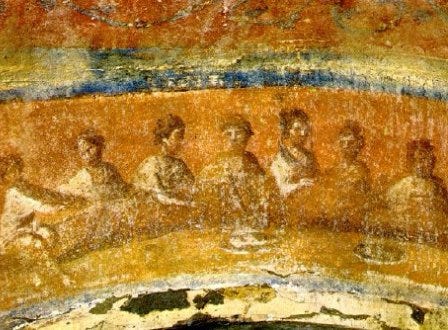
Fractio Panis (C2)
Now, there are no tares here. If one cannot reason thus, one cannot reason as Jesus himself reasoned. But in that case Christianity is simply false. Its very existence is an affront to everything holy and good. It has, though founded on a Jew and by Jews, become a font of Jew-hatred. In which case, the self-respecting Jew must go it alone against those who argue, gnostic-like, that the god of Moses is a defective god, invented by a defective people. The likes of Rev. Rozzini, I fear, will not prove of much help to him, nor will any other Christian.
Christianity has certainly been tainted by anti-Semitism and still is. It is necessary to acknowledge that and to repent of it. But if the followers of Jesus cannot take Jesus’ side in a very Jewish sort of dispute—a dispute about Moses and the prophets, about the temple and the possibility of right offerings to God—then there can be no such thing as a follower of Jesus.
Did Nikolai Berdyaev not make the same point in his rebuke of anti-Semitic Christians? It is possible, he said, to distinguish four types of anti-Semitism: the quotidian, the political, the racial, and the religious. The first three are morally verboten. The fourth, however, rightly understood, is required of the Christian. For Christianity,
in a profound sense, is a religious anti-Semitism; or more accurately stated, an anti-Judaism. Thus, whereas the quotidian or political hatred towards the Jews is completely impermissible for the Christian consciousness and completely alien to the religion of love, a religious anti-Judaism enters into the Christian faith as its component part.
This, he insisted, is merely the “reverse side of faith in the God-chosenness of the Hebrew nation.” In its wrestling with God, it is obliged to wrestle with what God actually does, not merely with what it thinks God could or should do. It is obliged to wrestle with Jesus.
The anti-Judaism of which Berdyaev speaks is neither anti-Semitism nor the structural “anti-Judaism” with which David Nirenberg wrestles in his book by that name. It is a Christian kind of philo-Semitism, the kind that sides with the Crucified. I would not myself label it anti-Judaism, however, for Judaism is a many-splendored thing. It did not come into existence, as some suppose, for the purpose of resisting the Christian gospel. It was already in existence for the purpose of surviving exile. That it was later used to resist the gospel of Jesus does not change that. It does not taint Judaism tout court. Yet we ought to agree with Berdyaev that witness to Jesus as the Christ should not be deemed a form of Jew-hatred. Rather, it is a choice between sides in a dispute between Jews as they wrestle with God. It is Jewish before it is Christian, whereas anti-Semitism is neither Jewish nor Christian. Jews, after all, proclaimed Jesus as messiah even before pagans in Antioch began calling them and their converts “Christians.”
Sick with the Judaizing disease
Speaking of Antioch, were we to visit fourth-century Antioch, rather than first, we might have the privilege of listening to a man said to be the greatest homilist since Paul. He was a presbyter named John, from a Syrian military family, who in AD 398 would become Archbishop of Constantinople, the Second Rome. Later generations would dub him Chrysostom, the man with the golden mouth. While still in Antioch, he gave on our topic eight homilies “Against the Jews” or “Against things Jewish.” He too is a canonized saint and Doctor of the Church, but in these homilies we find anti-Semitic tares sown among the wheat, tares that were later plucked from context and used in support of persecution of Jews themselves.
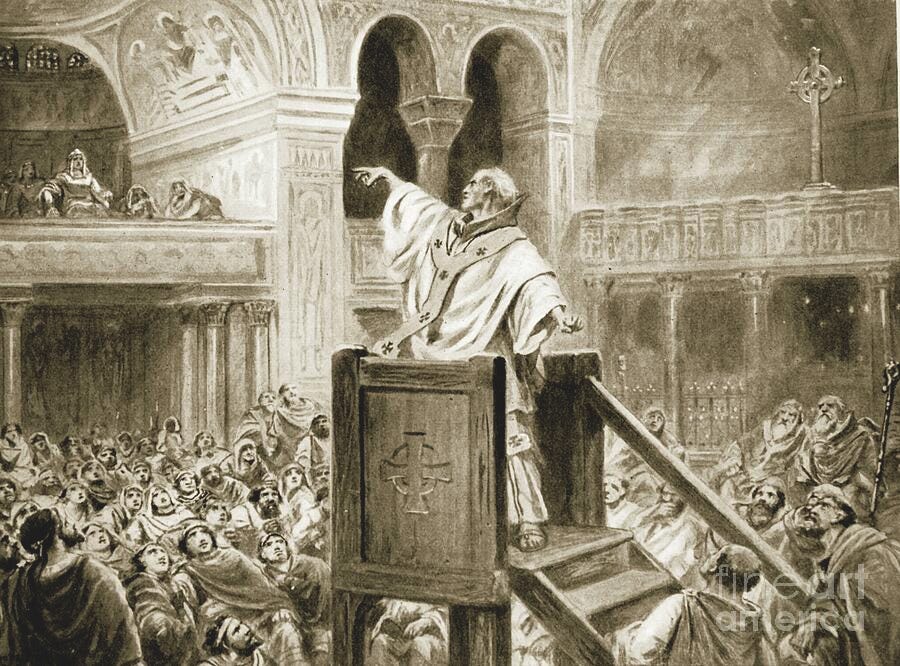
Dudley
When I say “plucked from context,” I do not mean that in context they were innocent. Some were more innocent than they sound, others weren’t. “This is the reason I hate the Jews: because they have the law and the prophets,” falls into the first category by telling us something about the context.
What was the context? It was not that of the Jew-hatred promoted by the pagan grammarian, Apion, in the first century. But it did have something in common. In A.D. 40 Apion led a delegation to Caligula, from Alexandria, in which he pressed the case for Jews in that city to be stripped of their rights. That sort of thing was on the rise in the pagan world. In the next generation, the Jewish historian Josephus would write his Contra Apion in defence of the dignity and antiquity of Jewish scripture and tradition. Chrysostom, for his part, would draw on those same scriptures, in which God is said to hate Jewish festivals and religious observances because of the people’s disobedience and hypocrisy, to discourage Christians from attending them. Some were attending them; so many apparently, that Chrysostom grew worried about their faithfulness to the church and its gospel. The common feature is just there, for his attack, too, was a reaction to the success of the local Jewish community, based on anxiety about its influence, though this was a quarrel between peoples of the book.
Here is a fuller quotation from Chrysostom’s first sermon on the subject, which helps explain the remark quoted a moment ago:
For they brought the books of Moses and the prophets along with them into the synagogue, not to honour them but to outrage them with dishonour. When they say that Moses and the prophets knew not Christ and said nothing about his coming, what greater outrage could they do to those holy men than to accuse them of failing to recognize their Master, than to say that those saintly prophets are partners of their impiety? And so it is that we must hate both them and their synagogue all the more because of their offensive treatment of those holy men.
There is a difference, of course, between hating festivals or ceremonies and hating those who hold them. But it is a great mistake, as the historian Robert Wilken points out in John Chrysostom and the Jews: Rhetoric and Reality in the Fourth Century, to suppose that Christians were already the dominant force throughout the empire and that John was urging violence against a minority community. Hellenist communities, devoted to Graeco-Roman religion and culture still flourished. Jewish communities also flourished. In Antioch Christians flourished, too, but competition was stiff. There had been Christian emperors, yes, from the days of Constantine, who lent them support, and now there was Theodosius; but there had also and quite recently been Julian, who despised Christianity and wished to undo its gains. As one piece of his strategy to discredit Christians and their reading of recent history, Julian even spoke of rebuilding the temple in Jerusalem. If Christians were no longer “strangers and exiles” in the political sense, if indeed they had sufficient influence now to put to a severe test their own theology and culture of exile—the emerging monastic movements were evidence that some thought the test was being failed—they had not yet secured establishment status. They were in no position to assault Jews in any literal sense, nor was that their intention.
The church was now heavily gentile in composition, however. Its Jewish instincts and sensibilities were fading, as it found itself in renewed competition with the synagogue for converts from paganism. That Christians in Antioch were rediscovering those sensibilities through the synagogue so bothered John that he thought it necessary to remind them that Jews had killed Jesus and the prophets before him, and had even fallen at times into the bloodthirsty, child-sacrificing idolatry of the Canaanites and Phoenicians. Like the lawyer he used to be, he heaped up against them every evidence of perfidy he could find. His mastery both of scripture and of rhetoric made him a formidable opponent. What came from his golden mouth in these homilies, alas, is covered in anti-Semitic dross. There can be no mistake about that.
In reading them, however, it is a further mistake, as Wilken makes clear, to ignore the rhetorical conventions of the day; those in particular of psogos or censure, in which he was trained. As Brother Gilbert Joseph Bloomer (a Hebrew Catholic) puts it, Chrysostom’s rhetoric
follows the conventions of classical invective, exaggerating and caricaturing in order to provoke an emotional break with what he perceived as a dangerous ambiguity of identity. Such language is intelligible within its pastoral and cultural setting, but it is not thereby normative or timeless.
Yet neither local exigencies nor rhetorical conventions can excuse the intemperate nature of John’s assault on “the Judaizing disease” and on Jews themselves. While there is precedent in the New Testament for both prongs of his attack, the way he conducts it evinces a polluting admixture foreign to the apostolic spirit. It is one thing to say, as John does say, “Nothing is more miserable than those people who never failed to attack their own salvation.” It is another thing to say, “Do you not shudder to come into the same place with men possessed, who have so many unclean spirits, who have been reared amid slaughter and bloodshed?” The right-minded Christian, says Bloomer, “affirms the gravity of the Passion without assigning inherited blame, honours the Fathers without absolutising their polemic, and confesses Christ crucified not as a weapon against a people, but as the one who heals Jew and Gentile alike by drawing all into the obedience of His Cross.”
Now, Jesus himself said some harsh things about his own people. He said some very harsh things about those in authority over them. He warned his followers how they could expect to be treated by them. “They will put you out of the synagogues; indeed, the hour is coming when whoever kills you will think he is offering service to God.” And so it was. The Christian and the Jew each had reason to regard the other as perfidious; that is, as a covenant-breaker: the one because he understood the Abrahamic covenant to have been ratified anew in the blood of Jesus and confirmed by God through the resurrection of Jesus; the other because he thought Jesus (though curiously not John) a blasphemer and refused to believe in his resurrection. For the latter, the Christian was a dangerous heretic, and for the former the Jew eventually came to serve as a cipher for heretics generally, which is why the hasty sometimes mistake remarks made about gnostics and other groups on the fringes of Christianity for remarks about Jews.
But Jesus did not say, “Do unto others as they have done unto you.” He commanded his followers to love their enemies, returning blessing for cursing. Which is exactly what he himself did, by submitting to death on a tree. That was not a retraction of the harsh things he had said, but rather a proof of them—a proof and a redemption, as Peter pointed out at Pentecost. Chrysostom fails here to emulate Jesus. He fails to emulate Peter and Paul. The latter’s concern was not about religious commerce with Jews! It was only about imposing circumcision on gentiles and so making out the Mosaic law to be the means of salvation rather than the cross of Christ. As he wrote to the Galatians,
Far be it from me to glory except in the cross of our Lord Jesus Christ, by which the world has been crucified to me, and I to the world. For neither circumcision counts for anything, nor uncircumcision, but a new creation. Peace and mercy be upon all who walk by this rule, upon the Israel of God.
It is a short step from talking about a Judaizing disease to talking about diseased Jews, and Chrysostom seems to have taken it, or at least to have invited others to take it. Those who do take it step out into a place where the ghost of Apion walks among men with blood-covered hands.
Be not proud
In the West, fortunately, a sounder view soon found articulation and prevailed for the better part of a millennium. Though in retrospect far from perfect, it had a balance both its admirers and its critics often lack. Jews and Christians may be estranged, argued Augustine, but in their own diaspora Jews have become, like Jonah, reluctant missionaries to the nations. They have been cast up on gentile shores, carrying with them the scriptures on which Christians also depend—scriptures that, rightly read, show Jesus to be the messiah and Christianity to be a divine work, not a novelty invented by heretics. Jews, then, despite their opposition to Jesus, are tolerated by God, and should be tolerated by man, in order to fulfill their present purpose. They are witnesses to Moses and the prophets, whom Jesus took as witnesses to himself.
They should be tolerated for another purpose as well. Paul has predicted their conversion at the end of the age. God is not done with the Jews; therefore Christians are not done with them either. They ought to be praying for their eyes and hearts to be opened to Jesus. Which implies something better than mere toleration. Even if their errors are not to be copied, whatever they have right may be integrated into what Bloomer refers to as the church’s moral-liturgical grammar, which at the outset was developed in that very fashion; it was borrowed from the synagogue.
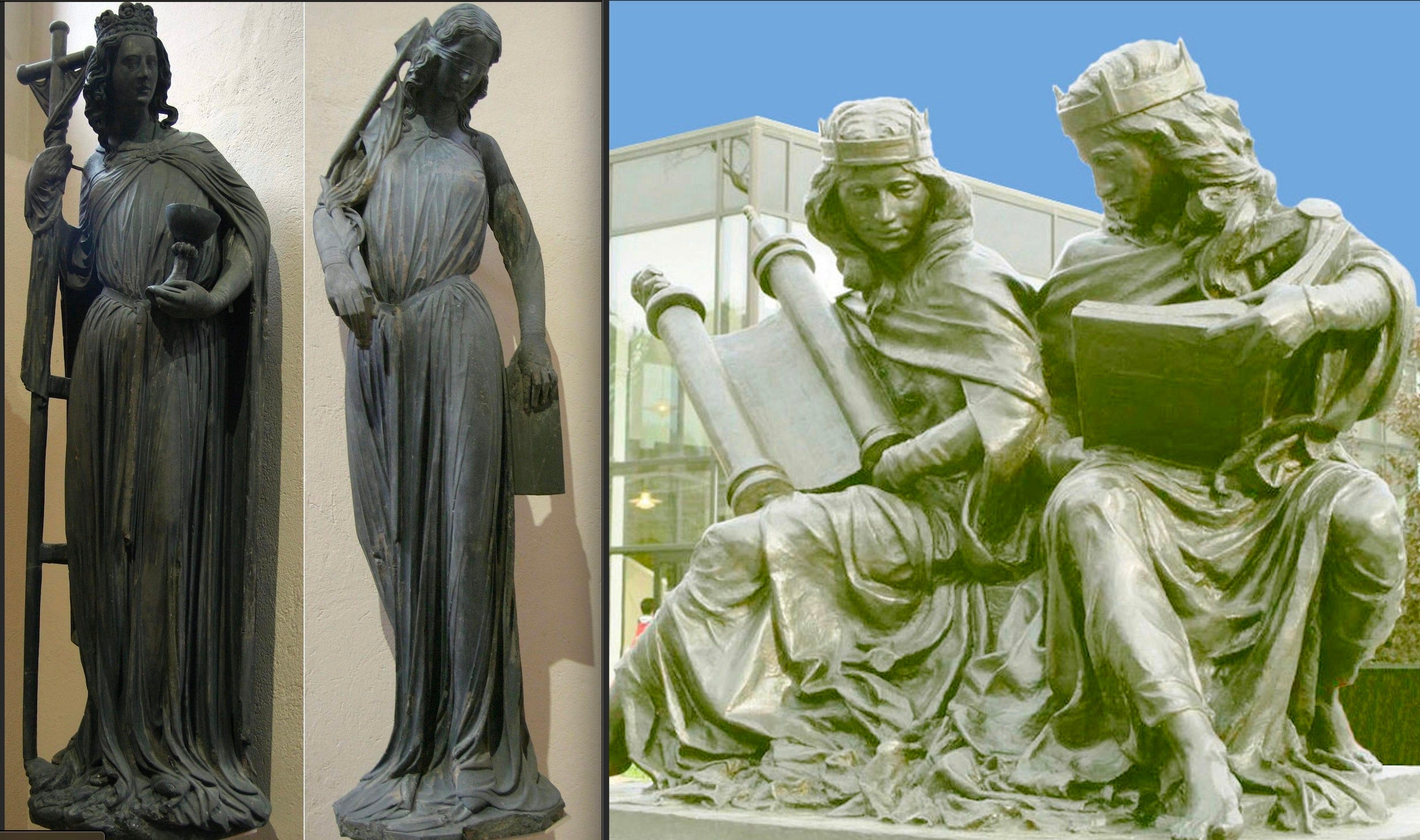
Ecclesia and Synagoga in Strasbourg and Philadelphia. Ecclesia is turned toward Synagoga, whether or no Synagoga is turned away from Ecclesia.

Augustine, however, could be quite stern about the Jewish stranger and his place in a city that had become Christian. In Contra Faustum, he allows for the Jew’s subjugation to laws and policies that applied also to pagans. This was a burden they would have to bear. At 12.12 he appeals to an Old Testament warning to the Jews, while adding a warning of his own to Christian gentiles:
“Groaning and trembling shalt thou be on the earth.” Here no one can fail to see that in every land where the Jews are scattered they mourn for the loss of their kingdom, and are in terrified subjection to the immensely superior number of Christians. . . Yet it is not as thou sayest. Not by bodily death shall the ungodly race of carnal Jews perish. For whoever destroys them in this way shall suffer sevenfold vengeance, that is, shall bring upon himself the sevenfold penalty under which the Jews lie for the crucifixion of Christ. So to the end of the “seven days” the continued preservation of the Jews will be a proof to believing Christians of the subjection merited by those who, in the pride of their kingdom, put the Lord to death.
A further purpose appears, then, a more problematic one. The subjugation of the Jew is an object lesson to all the proud. Moreover, what Jews suffer in this way they have merited by their rejection of their own true King. As in Chrysostom, so in Augustine; a doctrine of perpetual corporate guilt is in play, though here it is hedged round against abuse by a quite remarkable imprecation against those who think to exercise violence against Jews.
Augustine’s critics make much of this further purpose, for Christian civilization made much too much of it. They number Augustine among those guilty of a “replacement theology” that transfers every benefit belonging to old Israel to the church as “the new Israel.” We have already seen, however, in part one, that this is not the case, at least where the land is concerned. We must now see that Augustine both does and does not regard the church in this way.
One of the works offered in evidence against him is his Tractatus adversus Judaeos. But what does he argue there? He begins by arguing the continuity of the church with Israel, not its substitution for Israel. He turns to Psalm 80, a prayer for the restoration of Israel, to remark on this passage:
Thou didst bring a vine out of Egypt;
thou didst drive out the nations and plant it.
Thou didst clear the ground for it;
it took deep root and filled the land. . .Turn again, O God of hosts!
Look down from heaven, and see;
have regard for this vine,
the stock which thy right hand planted.
They have burned it with fire, they have cut it down;
may they perish at the rebuke of thy countenance!
But let thy hand be upon the man of thy right hand,
the son of man whom thou hast made strong for thyself!
Then we will never turn back from thee;
give us life, and we will call on thy name!
The vine and vineyard in question are one and the same, he maintains. “Christ did not plant another; by his coming he changed that one into a better one.” Immediately he appeals to Paul on the joining of gentiles to the righteous remnant of Israel. “By the just severity of God, the unbelieving pride of the native branches is broken away from the living patriarchal root and, by the grace of divine goodness, the faithful humility of the wild olive is ingrafted.” This is replacement theology of a sort; but not the sort in which one vine is abandoned and another takes its place, but rather the Pauline sort in which some branches replace others. A better name for it is remnant theology or fulfillment theology: “Through this son of man, Jesus the Christ, and from his remnant—that is, his apostles and the many others who from among the Israelites have believed in him as God, joined by an increasing abundance of gentiles—the holy vineyard is being completed.”
What, asks Augustine, is the alternative? “Are we to deny that the apostles and those churches of Judaea which, after the resurrection of Christ continued to believe in Him, belong to the house of Jacob?” Of course not. The church is founded on a righteous remnant. Did that remnant do things differently from what had hitherto been done under Moses? Yes, for they kept the commandments of Jesus. Augustine argues, however, exactly as Irenaeus had argued, that Jesus “did not change the ancient signs of things to come by censuring them; he changed them by their fulfillment.” Thus, “in the passing of the old rites and in the institution of the new,” the prayer for the restoration of Israel is answered.
None of this makes any sense, it may be conceded, if Jesus was not the messiah. For if he was not the messiah he had no authority to change anything. None of it makes any sense if we allow no distinction between natural and spiritual Israel, but that very distinction is constantly made by the prophets who point to the messiah. Has spiritual Israel “surpassed” natural Israel and “subdued” (subdit) it? Augustine appeals to Jacob and Esau: “the elder shall serve the younger.” Has the younger inherited the earth? Men from every nation have entered the house of Jacob. What remains, then, is that those who belong to natural Israel should themselves enter, if they have not done so. Augustine speaks to them with a kindly severity: “You, in the person of your parents, have killed Christ. For a long time you have not believed in him and have opposed him, but you are not yet lost, because you still live. You have time now for repentance; only come now. You should have come long ago, of course, but come now; your days are not yet ended; the last day is still to come.”
There are those who insist that this is unkind and unjust, because it regards the remains of natural Israel as a heap of broken branches and as a people carrying inherited guilt for hanging Jesus on a tree. Before we concede that, however, we must press the question about an alternative. “In the person of your parents” is certainly a biblical notion. “His blood be upon us and upon our children” was their parents’ notion. That they had a choice and that their choice had consequences cannot be denied. What did Jesus say when he had shed his tears over Jerusalem and delivered his parable of the wicked tenants? “Therefore I tell you, the kingdom of God will be taken away from you and given to a people producing the fruits of it. And he who falls on this stone will be broken to pieces; but when it falls on any one, it will crush him.”
We cannot set any of this aside without setting aside either the special vocation of natural Israel—as Berdyaev says, it is the reverse side thereof—or the special vocation of spiritual Israel. We cannot set it aside without breaking the bond between these vocations. David: “The LORD said to my Lord, ‘Sit at my right hand, till I make thy enemies a stool for thy feet.’” Peter: “Let all the house of Israel therefore know assuredly that God has made him both Lord and Christ, this Jesus whom you crucified.”
But here we must jump ahead, momentarily, to the present day. Has the situation not changed with the reconstitution of political Israel in 1948? Might we see that event, which Augustine did not foresee, as a divine answer to the prayer of Psalm 80?
O Lord God of hosts,
how long wilt thou be angry with thy people’s prayers?
Thou hast fed them with the bread of tears,
and given them tears to drink in full measure.
Thou dost make us the scorn of our neighbors;
and our enemies laugh among themselves.Restore us, O God of hosts;
let thy face shine, that we may be saved!
It is true that Israel as a nation is no longer subdued. It is true that the enemies of that nation no longer laugh among themselves, though they still scorn and rage at their neighbour. It is also true, I think—let us at least allow that it may be true—that the re-emergence of a Jewish national polity is a work of God and not of man only. It may even be a sign that God is not forever angry with natural Israel. It is certainly not true, however, that God and man, where the mediator between God and man is left out of account, are doing the same work. It is not a sign that God will restore natural Israel without reference to the Son of Man, as if there were two paths to fulfillment: one for the spiritually inclined who abandon the Jerusalem below for a putative Jerusalem above, and another for those who believe in the former but not in the latter, and think Christians deluded in speaking of the latter. Augustine would have no truck whatsoever with that kind of thinking, nor should we.
Christians and non-Christian Jews may alike be strangers in Babylon, which Jews very evidently remain even when regathered in their ancient land, armed with their own legal and military instruments. Christians and Jews may also be estranged from one another and in need of reconciliation, but reconciliation cannot be had by bracketing out questions of authority. How can it be had, according to Augustine? Within a true polity, an apostolic polity. “Therefore ‘they shall be your judges,’ to whom Jesus makes this promise: ‘You shall also sit on twelve thrones, judging the twelve tribes of Israel.’ That is where the house of Jacob, which has been called and has walked in the light of the Lord, will sit to judge the house of Israel; that is, the people of that house whom He has cast off.”
Is that just Christian triumphalism? Note well what follows in the Tractatus, namely, a plea to see that God wills to bring together those who have been estranged that they might exchange the kiss of peace:
How is it that, according to the same prophet, “The stone which the builders rejected: the same is become the head of the corner,” unless because circumcised and uncircumcised meet and unite in the keystone, like the union of two adjacent walls, as it were, in the kiss of peace. That is the reason that the apostle says, “For he himself is our peace; he it is who has made both one.” They who have followed his call—whether from the house of Jacob or from the house of Israel—are cleaving to the corner-stone and walking in the light of the Lord. They, however, whom God cast off from the house of Jacob or of Israel are themselves builders of destruction and rejecters of the corner-stone.
If we turn to Sermon 27, another of his writings appealed to both by critics and by false friends, what do we find? We find him condemning Christian pride and stubbornness, along with Jewish pride and stubbornness. “Why did the natural branches deserve to be cut off, except for pride? Why the wild olive tree to be grafted in, except for humility? . . . Let us then learn, or let us hold fast, humility. . . If we have it not yet, let us have it, that we may be grafted in; if we have it already, let us hold it fast, that we may not be cut off.”
The house of Israel, he insists, “was not wholly condemned, but sifted.” They are still being sifted, we may add, and will be sifted yet; the church likewise. Was it their pride that turned them away at that time? But perhaps it is our pride that has turned them away since. We will see that pride at work in the fourth model. But on the model of Augustine, humility and hope are the lessons to be learned: “Who should despair of the forgiveness of his sins, when the crime of killing Christ was forgiven to those who were guilty of it? They were converted from among this people of the Jews; were converted, and baptized. They came to the Lord's table, and in faith drank that blood, which in their fury they had shed.” For “in putting their Physician to death, though they knew it not, they were preparing a medicine for themselves.”
In his exposition of Psalm 59 he speaks likewise, though his critics use that text as well to discredit him. Rebellious Jews, he says, can be numbered among the enemies of God. Yet, like Cain, they have a mark of protection. They have lost their temple. They have been subjected to Rome, as have the pagan nations. Yet they have not been absorbed into Rome. “This is the mark which the Jews have: they hold fast by the remnant of their law, they are circumcised, they keep Sabbaths, they sacrifice the Passover; they eat unleavened bread. These are therefore Jews, they have not been slain, they are necessary to believing nations. Why so? In order that He may show to us among our enemies His mercy.” What does he mean? “Behold where they lie, that were proud; behold where you have been grafted, that lied: and be not proud, lest you should deserve to be cut off.”
Be not proud! For if “all vices in evil-doings are to be feared, pride in well-doings is more to be feared.” Emulate rather the Lord.
Among them he was walking humbly, and they were made guilty by shedding the blood of the humble one. But not all of them. This even today we commend to the notice of your love: not all. Because many of them were turned to him whom they slew and, by believing on him, they obtained pardon even for the shedding of his blood. They have provided an example for all men, how they ought not to despair that sin of any kind might be remitted, since even the killing of Christ was remitted to those who confessed...
The Jew and the gentile “dog,” having been found alike in iniquity, shall alike attain to salvation, if “in the ‘corner stone’ being united, they have together worshiped the Lord,” though the former be converted “only at evening.”
See ye the Corner exulting, now with both walls rejoicing. The Jews were proud, humbled they have been; Gentiles were despairing, raised up they have been: let them come to the Corner, there let them meet, there run together, there find the kiss of peace; from different parts let them come, but with differing not come, those of circumcision, these of uncircumcision. Far apart were the walls, before to that Corner they came: but in the Corner let them brace themselves, and now let the whole Church from both walls say what? “I will sing of your power, and I will exult in the morning of your mercy.”
Are you Israel?
On that happy note we will part from Augustine, who is convinced that “nothing is incurable to the Great Physician.” Problematic elements notwithstanding, his approach does not differ substantially from that of the apostolic fathers or of the Vatican II fathers, who in Nostra Aetate renounce the false pride of gentile Christians and the accompanying abuses inflicted on Jews, while maintaining in Lumen Gentium the essential message of the apostles themselves.
Christ instituted this new covenant—the new testament, that is to say, in His Blood—calling together a people made up of Jew and gentile, making them one, not according to the flesh but in the Spirit. This was to be the new People of God. For those who believe in Christ, who are reborn not from a perishable but from an imperishable seed through the word of the living God, not from the flesh but from water and the Holy Spirit, are finally established as “a chosen race, a royal priesthood, a holy nation, a purchased people . . . who in times past were not a people, but are now the people of God.”
Let no one say that this is replacement theology. Myself, I will go so far as to say that even the theology of Justin Martyr, the supposed founder of replacement theology, is no such thing. How does Justin respond to Trypho’s incredulous query, “What then, are you Israel?” Not by saying, “Yes, and you are not,” as the editorial header at §123 implies, but rather by explaining that Christ himself is the true Israel, as are all who are joined to him through baptism.
Appealing to Isaiah 19, Justin rebukes the mockers who accompany Trypho for the deception they practice on themselves, as if they “alone” were the Israel God promised to bless, and for execrating gentiles whom God has blessed with true sonship. But Justin does not exclude natural Israel when he blocks the move to exclude the gentiles who belong to spiritual Israel. Nor does he condemn all Jews as unspiritual when he says of those mockers that they are “lawless, wandering sons” who are “utterly incompetent to know the hidden will of God.”
Replacement theology that does exclude and condemn, though it can be found in Chrysostom and others, takes hold in the West only in the second Christian millennium. Ironically, it is in a Jewish convert to Christianity that it clearly manifests itself. To him we now turn in conclusion.
A byword and a curse
Petrus Alfonsi, to use his Christian name and adopted surname, taken in honour of Alfonso the Brave, was native to Huesca, a Muslim city in Spain. He was baptized in 1106, less than a dozen years after the infamous pogrom in the Rhineland that marred the outset of the first crusade, and wrote on our subject about three years later. By his lights, the Talmudic Jew was in perpetual exile among the nations because he was guilty of the death of Christ, a sin greater than all others yet one for which he stubbornly refused to repent. In refusing, he remained an object of God’s special wrath. He also remained in thrall to envious and carnal teachers, men of the sort Jesus had condemned in his parable of the wicked tenants, men who had deliberately killed one whom they knew to be divine.
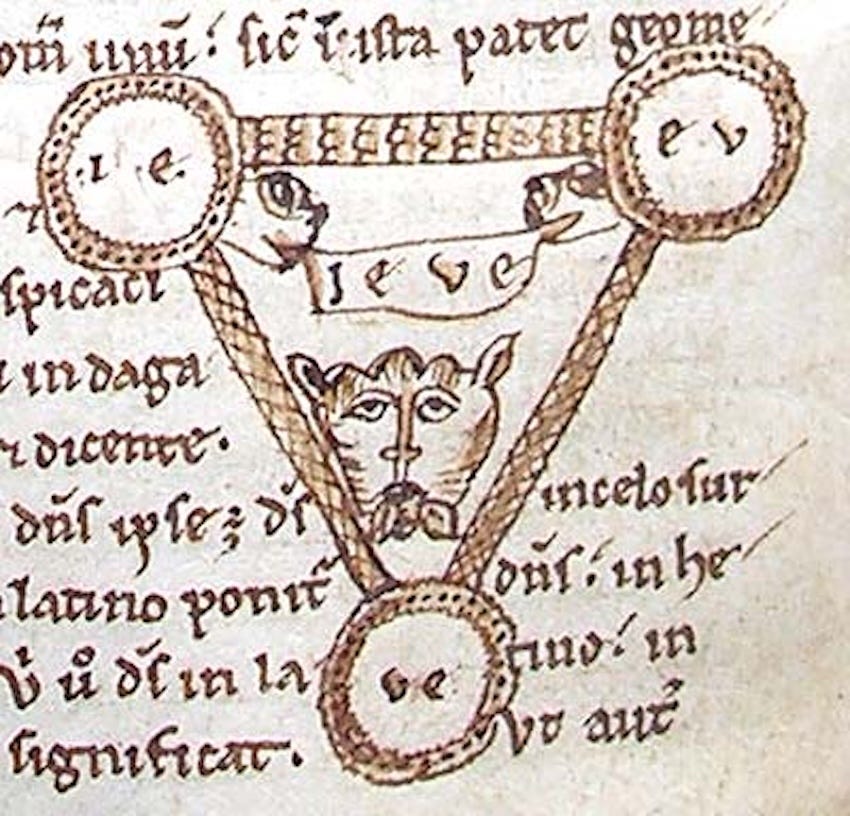
This diagram is drawn from a manuscript of Alfonsi’s Dialogue against the Jews, illustrating one of its arguments by superimposing a trinitarian symbol on a Jewish one, while rendering a Christian interpretation of the divine name revealed to Moses. That is very much in keeping with Christianity’s commitment to covenantal continuity, a commitment augmented by Alfonsi’s intimate knowledge of the Talmud. But his work is adversarial. It belongs, as its translator Irven Resnick points out, to “a growing polemical antiphon of Jewish-Christian debate” that can be traced back to a ninth-century Jewish tract, Nestor the Priest. Sixty years later, Jacob ben Rueben, who also hailed from Huesca, would respond in kind with Milhamot ha-Shem, Wars of the LORD.
There were better lights to follow in that era. Anselm, in Cur Deus Homo, had rejected the notion that the Jewish leaders knowingly killed the incarnate Son of God. The charge that they were guilty of deliberate deicide had no basis. Anselm’s pupil, Gilbert Crispin, in his Dispute between a Jew and a Christian (c. 1093) had recounted a civilized debate about Jesus that didn’t resort to such fantastic ideas. Alfonsi’s contemporary, St Bernard, in Sermon 79 on The Song of Songs, spoke persuasively of the church’s longing to introduce her bridegroom to her mother, the house of Israel; that is, to introduce Messiah Jesus as the one who restores to Israel her lost salvation. He also intervened during the second crusade, defending Jews from violence by those who had forgotten Augustine’s sevenfold imprecation.
Better lights, then, and more generous spirits. It is worth noting as well that, in the early fourteenth century, a Castilian convert from Judaism, Abner of Burgos—who likewise adopted the Alfonso family name—produced a much longer and more sympathetic dialogue than that of Petrus Alfonsi. Alluding to dreams he had experienced, he called it Teacher of Righteousness. This work, written in Hebrew not Latin, gained a far wider hearing among Jews. Ryan Szpiech observes that Abner preserves some “faith in the Talmud and important teachings of the Rabbis,” hoping “to transform the stark opposition between Christian and Jew . . . into an opposition between those who seek truth . . . and those who merely follow tradition.” But Petrus, rather than Abner, would have the greater influence on Christians.
Petrus approved of the charge of deicide and held a strong version of collective guilt. The unsurpassable sin of the Jews could be remitted on an individual basis, by repentance and conversion, through the mercy (not the justice) of God, but Jewry as a whole stood condemned. Without conversion, perpetual suffering was their fate, in time as in eternity. In the mouth of his former self, whom he dubs Moses, he puts a concessionary response to that stark warning: “If [Jesus] was a man such as you say, and his death was the cause of our tribulation, none of us would deserve to live. For a sin such as this [knowingly killing God] is greater even than denying God.”
Yet, argues Moses, this evidently is not the case, since the Jew does in fact live. He lives as beneficiary of God’s promise that, even “when they are in the land of their enemies, I will not spurn them, neither will I abhor them so as to destroy them utterly and break my covenant with them; for I am the Lord their God.” To which comes this rejoinder from Petrus:
God does not suffer the remnant of your people to live because he plans something to their advantage, but only so that you serve all the nations and so that you would be in the eyes of all a reproach and a byword and a curse, just as the giver of the law promised, saying: “You shall become a horror, a proverb, and a byword, among all the peoples where the Lord will lead you away [into exile].”
And so shall you be . . . for all those enquiring of one another: “What do you think is the reason that God has subjected to perpetual servitude this people, which is dispersed everywhere across the earth, and why has he condemned it with the penalty of so many evils?” And someone will answer: “On account of a sin such as this, that they slew the Son of God solely because of envy; for this reason they arrived at these evils.”
Here we may interject that, in texts such as those to which Petrus alludes, what the divine Suzerain says to his people about the consequences of treaty-breaking is not beggared by the reality of their later experience. God warned them with in full, leaving little to the imagination. But that warning in no way excuses anyone, and certainly not Christians, for their violence against Jews. Petrus, however, seems to provide an excuse when he goes on to say that “the testimony of divine compassion that was extended to you . . . does not concern the present captivity but has to do with the Babylonian captivity that has already passed.” At that time, he opines, the Jews were preserved by God for the sake of the Abrahamic seed, Jesus. What is there now to preserve them for, except that they should be a proverb and a reproach? On his view, only Christians are beneficiaries of the promises remaining to the children of Israel.
Petrus doesn’t speak of the church as a new and different Israel, but that is the impression he leaves. The church from Jews and gentiles is not so much Israel renewed as a substitute for Israel. Whereas Augustine never tires of repeating the teaching of Paul that gentiles are grafted into the original vine, Petrus hardly mentions Paul. Though a Jew himself, his model is fraught with anti-Semitic elements. It is moved by a spirit that has rightly been repudiated by the church, though it can still be found in the church. An era of Christian persecution of Jews—justified in low places and sometimes in high—had begun. For some, mistreatment of the Jew qualified as a divine work.
This was the era in which the blood libel would take root, the myth of ritual murder, the kernel of which can be found in Apion; that is, in his account of a Greek slave supposedly liberated from the temple by Antiochus IV (on which see Nirenberg’s first chapter). That rooting began with the death of young William of Norwich on Good Friday in 1144, whose family claimed that he had been killed by Jews. From there, says Sandra Miesel in a brief but instructive summary of its history, it “spread like a virus across Europe, all the way to the Orthodox and Muslim East.” It has analogues in the Jew-blaming and anti-Zionist rituals with which we ourselves are familiar.

Montreal
There is a related problem with Alfonsi worth mentioning in passing, for it bears on matters to which we will later return. Did Jesus, he asks, “have to remain behind in the squalor of this world after the resurrection?” No, “he abandoned it” and in his lightness “rose up into heaven,” whence “glory has to come upon him across the entire earth.” The Jew, in the grossness of his carnal nature, his fixation on Jerusalem, and in his expectation of resurrection to more of the same, neither beholds that glory nor contributes to it. He does not understand that the Lord God “enlarged the borders of Israel after Christ’s advent, when the apostles preached his law throughout the entire world.” Nor does he see that “even the place that the Lord chose, so that his name should be there, is now far off [from him], because that ancient temple of the Lord has been destroyed” and replaced by the temple of Christ’s heavenly body.
There is a moment of truth here. God has indeed enlarged the borders of Israel by making of Christ “a living temple” for the nations. The centre of gravity, so to say, has shifted with Jesus to the Jerusalem above, until the consummation of a process of which the Apocalypse speaks in its penultimate chapter: “I saw the holy city, new Jerusalem, coming down out of heaven from God, prepared as a bride adorned for her husband; and I heard a great voice from the throne saying, ‘Behold, the dwelling of God is with men. He will dwell with them, and they shall be his people, and God himself will be with them.’”
On the other hand, Petrus is working with a verticalized, spatialized, de-eschatologized cosmology typical of his time. Jerusalem is just a dot on a map, lying far below that heavenly vanishing point where Jesus reigns above. On such a construct it is difficult to know what to do with the Jew other than to dismiss him, in his stubborn Jewishness, as something too “heavy” to properly glorify God. Even those motivated to liberate Jerusalem from Muslim hands thought nothing, in some cases, of “liberating” Christian lands from Jews. This construct (as I argued in Ascension and Ecclesia) prepared the way for the resurgent gnosticism of more recent times, in which the body as such is increasingly despised, and the Jew especially despised.
According to Alfonsi, the only escape open to Jews, from their much longer and harsher Roman captivity, is to confess Jesus as Son of God and to keep his precepts. Spiritually speaking, that also is true, if only in a sense that applies equally to gentiles. For in this sin-sick realm, every man suffers an exile of something up to a century and then dies, after which comes judgment; and the judge, for which he should be most thankful, will be Jesus, who has wrestled with God on his behalf.
On the political level, however, it is not true. Under Christian princes, as under Pagan or Muslim or Secular princes, the Jew has often been relatively free and able to flourish, as he once did in Antioch and Alexandria and still does in New York, while at other times he has suffered harassment, banishments, slaughter, and holocaust. In Israel today, despite hostility and danger, he is free. And this fact seems to grate on those of Alfonsi’s persuasion, who respond to it much as those of Chrysostom’s persuasion responded to Julian’s plan to rebuild the temple. But not all are of that persuasion. To Christian Zionists, and the challenge actually posed by Zionism, we will turn in part three.
Mr Farrow, this series is fascinating. Thank you for taking the time to prepare it.
In short, the life, death and resurrection of Jesus Christ, our redeemer and Lord, son of God and second person of the trinity, made Jerusalem irrelevant.
Christian Zionists, take note.