
Wrestling with God
Zionism in Christian Perspective, Part One

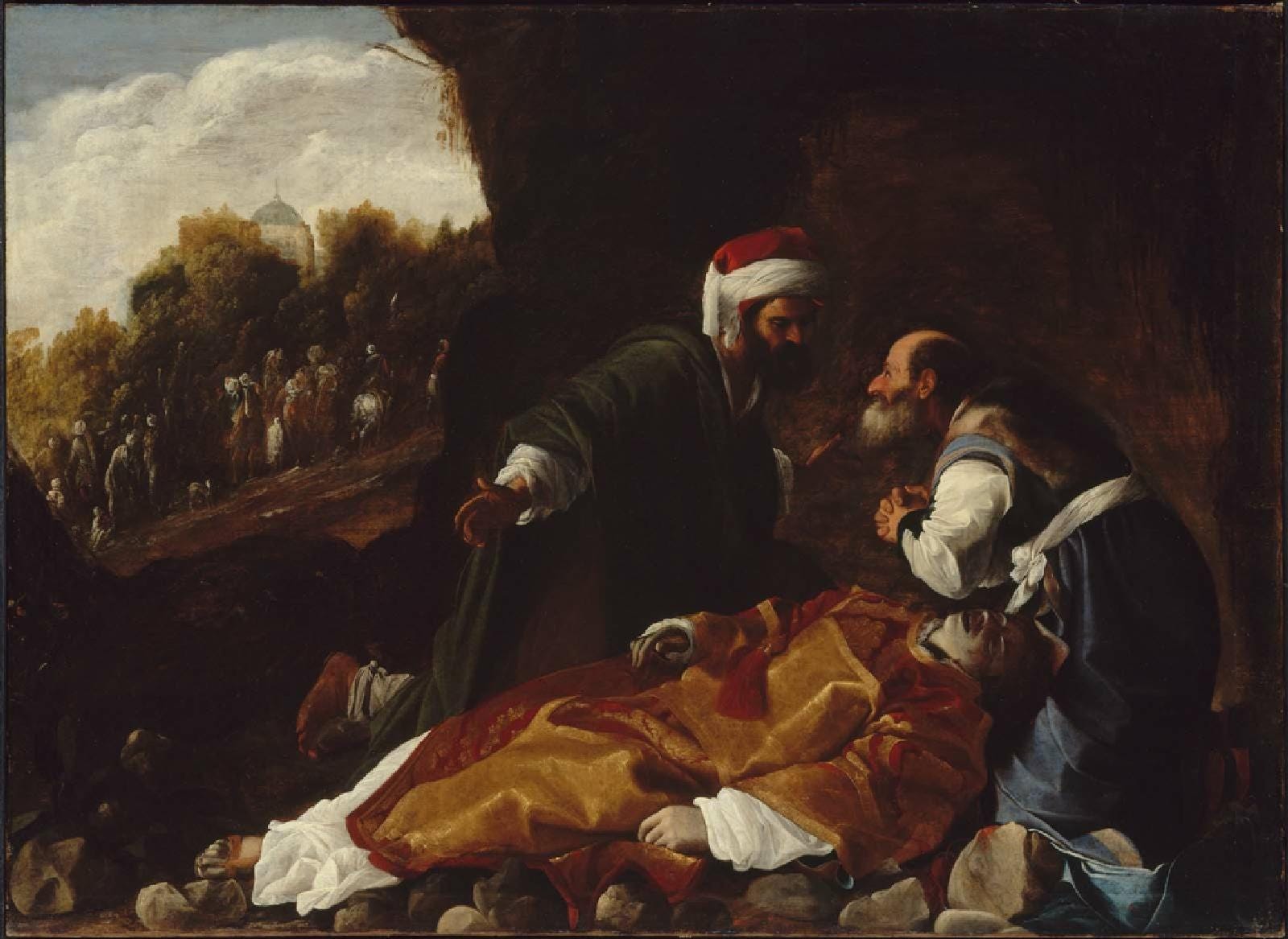
Gamaliel and Nicodemus with the body of St Stephen

“So, in the present case I tell you, keep away from these men and let them alone; for if this plan or this undertaking is of men, it will fail; but if it is of God, you will not be able to overthrow them. You might even be found opposing God!”
These words were spoken to the Sanhedrin by that venerable expert in the law, Gamaliel, when the apostles were first proclaiming Jesus as the Christ. The council, we are told, heeded his advice, but before releasing them exercised its powers of censorship by having the apostles beaten and forbidden to speak further. Those who know the story will recall that they had already been released once, by the hand of God, so their re-release at the hands of men was prudent, with or without the wise counsel of Gamaliel. That counsel was wise, however, and can make us wise today in dealing with Zionism, which has lately roiled the world on a scale almost comparable to that of the apostolic preaching.
To become wise, however, we need to make a few basic distinctions and keep in view some elementary facts of history, scripture, and theology. Though no Gamaliel, I will try to help with that here.
What is Israel?
Israel is first and foremost the name of a person. Or rather, it is the new name of a person, a name bestowed by God not man. “Your name is Jacob; no longer shall your name be called Jacob, but Israel shall be your name.” Ya’akov becomes Yisra’el, for he has wrestled with God, albeit in some ignorance about God; and he will wrestle with God still, even after God has revealed not only his face but his holy name.
This wrestling continues today. Ya’akov, he who at birth “follows after” his twin, Esau, he who also “supplants” him in receiving the divine blessing, is still supplanting. His descendants, that is, are supplanting those of Abraham’s first son, Ishmael, and other peoples of Palestine. In this supplanting, he is wrestling both with man and with God. He knows this, though he does not always understand this. But already we have moved beyond the first, irreducibly personal referent, towards the further referents of the word “Israel” that we require if we are to understand Zionism. These are four, or fourfold.
Ethnic: the people descended from Abraham through Isaac and Jacob, including those who gain entry to that people, sharing their customs and way of life. Members of this people, whether by descent or by adopting the practice of Judaism, are known by synecdoche as Jews (yĕhūḏī, from Judah, the tribe of David and of the messiah).
Geographical: the land promised to the patriarchs, the land God said he would wrest from the Canaanites and bequeath to Abraham and his seed, the land that Christians call the Holy Land. This is identified as what can be viewed to the four corners of the compass from a mountain between Bethel and Ai, somewhere to the north of Jerusalem. Its boundaries, then, are rather hazy, though the biblical baseline is from the Jordan to the Mediterranean and from Dan (Laish) to Beersheba.
Political: the structured society or polity operative there, with its institutions and instruments of governance. In biblical times, this polity was ostensibly covenantal, theocratic, and dependent on the ministry of prophets, priests, princes or kings. Today it is ostensibly democratic and independent of such offices, though not of the corruption that often attended them.
Religious: those who practice some form of Judaism; that is, of the Talmudic religion that evolved, after the destruction of the second temple and the new diaspora, to preserve and adapt an halakhic mode of life rooted in canonical torah, oral torah (mishnah), and rabbinic commentary thereon (gemara).
More theologically: the people in good standing with the God of the covenant; that is, those collectively referred to in the prophets as the righteous or justified, as God’s servant, as a remnant preserved by God even in the midst of judgment and disaster. Paul, a student of Gamaliel, refers to them as “the Israel of God.”
Catholic Voices for Israel (CVFI) offers a tidy summary in saying that the term Israel refers to “the Jewish people, their covenantal identity, their historic connection to the land, and the modern State.” Here the order is slightly different—ethnic, religious, geographical, and political—and the last of these is more narrowly identified with the present polity; that is, with a modern state that is, like most modern states, in a rather sorry state. For “and the modern State” I would substitute “and their polity,” taking in the whole sweep of Israel’s history, which has known many different polities. It is with recent history, of course, that we are concerned when we speak of Zionism.
Zionism, Jewish and Christian
“In its most basic sense,” says the same source, “Zionism refers to the Jewish people’s biblical and historic attachment to the land of Israel and their right to national self-determination in their ancestral homeland.” That is something CVFI thinks Catholics can and should support. I agree, though again I will offer a qualification or at least a clarification; viz., that the right in question is a natural rather than a divine right, standing at present in uncertain relation to the promises of God and the rights they confer. It must be admitted, however, that Zionism is inextricably bound up with biblical faith and religion. That, in the last analysis, is why it is so controversial. It is why Israel itself, in all four senses, is controversial.
Zionism, even where it is not religious, is only possible because of the belief that God has preserved the Jewish people for the sake of the destiny he has promised them, and that this destiny includes the land. To say otherwise is to say either that there never was any such promise, perhaps even no God to make it, or that the promise could not be kept in perpetuity, which comes to the same thing. It is also to say that the Jewish people have somehow miraculously preserved themselves, unless they have been preserved as an object of divine wrath, which is what some people say. We will come to them later, but they are not representative, any more than deniers of the promise itself are representative. In any event, absent the belief in question, Zionism is not really thinkable.
Now, in Christianity, Zionism is eminently thinkable. For Christianity itself is centred on Jerusalem, where Jesus died and rose again, not on Rome or on Constantinople. Rome, to be sure—which according to Augustine “was founded as a second Babylon” and certainly had that character, beginning with violence and dissolving in violence—is where the holder of the keys was led by the Spirit of God to dwell. St Peter bore witness at the heart of the empire to the same world-transforming truth he had already proclaimed in Jerusalem, the truth about the Prince of Peace; as did Paul, who took a more circuitous route to get there. At the conclusion of his first epistle, written to the Christian diaspora, Peter signs off: “She who is at Babylon, who is likewise chosen, sends you greetings” (1 Pet. 5:13; cf. Civ. 16.17).
Rome, I repeat, is not a second Jerusalem but a second Babylon. The Catholic Church remains centred there only because that is where the martyrial bones of Peter and Paul are. If Jesus’ bones were still in Jerusalem, that is where the church would itself abide. But of course, if Jesus’ bones were anywhere but in his resurrected body, there would be no church! There is a church, and it is apostolic. It remains in Rome for the sake of its mission to the gentiles. It nonetheless remains oriented to Jerusalem, where the Saviour of the world lived, died, and rose again.
Christians make pilgrimage to the tombs of many saints, all over the world. They make pilgrimage to Rome. But above all they make pilgrimage to the city of the cross and the empty tomb. They belong to the Jerusalem above, but they have not let go of the Jerusalem below. The crusades also attest to that, even if they have let go of crusades. Only a gnostic could abandon Jerusalem. So a Christian can hardly be surprised at the longing of the Jew for Jerusalem, even the Jew who doesn’t believe in the resurrection of Jesus or, Sadducee-like, doesn’t believe in resurrection at all. The Christian shares with the Jew the knowledge that God has chosen Zion as an eternal dwelling place for his name. His belief in the heavenly Zion does not eliminate his love for the earthly Zion, which is where he expects to greet Jesus in the flesh on the day of resurrection.
There is an important difference, however. Christians are not a people in the same sense that Jews are a people. Christian kinship is inter-ethnic and global. It is a kinship that rises above secular politics, though it is not itself without a polity or without political implications and interventions. It is a kinship established and sustained, not only by liturgies and litanies, but by sacraments; especially by baptism and the Eucharist, a sacrifice that is a real participation in the body and blood of Jesus. In that sense it is certainly a physical kinship as well as a spiritual, but it is also a communion with angels as with men. For Jesus has ascended on high, establishing a heavenly Zion that is “a supremely ordered, supremely cooperative, association” of all creatures destined to “enjoy God and one another in God.” As the author of Hebrews says, in his great homily on the subject:
You have not come to what may be touched, a blazing fire, and darkness, and gloom, and a tempest. . . You have come to Mount Zion and to the city of the living God, the heavenly Jerusalem, and to innumerable angels in festal gathering, and to the assembly of the first-born who are enrolled in heaven, and to a judge who is God of all, and to the spirits of just men made perfect, and to Jesus, the mediator of a new covenant, and to the sprinkled blood that speaks more graciously than the blood of Abel.
When this difference is taken into account, it is obvious that not everything promised to Abraham is promised to his seed in precisely the same way. The promise of the land is especially for his seed according to the flesh. It is made to the Jew (Civ. 16.18). It touches on the very Jewishness of the Jew. Even during periods of exile, for breach of the covenant, the land continues to belong to the Jew by covenant. Christians, Augustine suggests, can help maintain the promise by proxy, as it were, through their own presence in the land when the Jewish presence is sparse (16.21). We may certainly call this, though Augustine did not, Christian Zionism.
Zionism as a Problem of Nature and Grace
Now, Augustine did not foresee the rise of Islam. He did not foresee the holocaust. He did not know anything about the Zionism of our own day, which would bring Jews back into the land, even into Jerusalem itself, in great numbers. He did not have to wrestle with the fierce and often destructive competition between Jews and others in the land. A Zionist project about which the question must be asked in all seriousness, “Of God or of men?”, did not appear on his horizon, as it has on ours. I’ve no doubt, however, that he would expect us to approach it theologically, as we are trying to do here, not pragmatically only. And one theological distinction we need to make is the distinction between a natural and a divine mandate.
This distinction can be illustrated with marriage. God creates the woman for man, as he has created man for woman. It therefore belongs to the natural order for a man to leave his father and mother and cleave to his wife by covenant, and so to be fruitful and multiply in a manner that produces order not chaos. Man, made male and female by God, has this mandate naturally, though not every man or woman can or need embrace it in practice. But it is possible, within the supernatural order, for it take on a sacramental dimension: what Christians call holy matrimony, through which is established not simply a natural family unit but also a domestic church, by dominical command indissoluble. It is enmity towards the latter, I dare say, that has driven the attacks on the former that we have witnessed in our own time, a time in which there is a general rebellion against both natural and supernatural order that, absent repentance, must destroy our civilization as surely as it destroyed Sodom.
If, by analogy, we apply this distinction to the matter at hand, we may say something like this: God, who “made from one man every nation of men to live on all the face of the earth, having determined allotted periods and the boundaries of their habitation, that they should seek God, in the hope that they might feel after him and find him,” determined the land in question for the Jew and, just so, promised it to Abraham. He did so that, under the guidance of Moses, the seed of Abraham according to the flesh might feel after him and find him with more certainty and a fuller knowledge than the rest, and thus aid and bless the rest.
To the natural mandate, then, was added a supernatural, both in their escape from Egypt and in the gift of torah, and indeed in the conquest of Canaan, for which the fall of Jericho served as paradigm. The supernatural mandate was summed up in the promise, “If you will obey my voice and keep my covenant, you shall be my own possession among all peoples; for all the earth is mine, and you shall be to me a kingdom of priests and a holy nation.” And in the oft-repeated refrain, “I will be your God, and you shall be my people, and I will dwell among you.” For that says much more than is said generally of all men: “He is not far from each one of us, for ‘in him we live and move and have our being.’”
The natural mandate is good, but the supernatural far better, for it means that they can enjoy, not only the land, but God in the land, dwelling with and among them. In this way, the land would become as Eden and their prospects, like those of Adam and Eve while they remained in Eden, would include immortality. They would be able to discover the abundant life not only in the present age or world order, but also in the ages without end, in the life of the world to come. For the natural serves the supernatural. Nature exists for grace and grace, as Thomas says, takes nature for its starting point.
Grace is distinct from nature, and nature from grace. Yet grace scorned deprives nature of its own purpose and meaning, of its very naturalness as a starting point. Can the lesser mandate, then—this land is for the Jewish people—be taken as granted when the greater mandate—this land is a place where God will dwell with his people—is rejected? The answer is No. Dust to dust, ashes to ashes, Babylon to Babylon.
Yet God preserves a righteous remnant, a true servant and steward. Even when that remnant is reduced to one only, the one God “makes from one” a company of the righteous, not only from the Jews but from every nation. And this company enjoys fulfillment of the promise, “I will dwell among you.” It is grateful, obedient, eucharistic. It has within itself the hope of immortality. Hence it is martyrial, and its own blood is like seed. It is fruitful and multiplies. In it and through it the nations learn, the angelic powers themselves learn, that God does nothing in vain and that his purposes do not fail. Nature is saved by grace. Grace fulfills nature while transcending nature.
These things do not happen all at once, however. And if we ask what is happening today as regards the land allotted by God to the Jews—allotted from the beginning but granted only when the time was right, when Abraham through faith had gone forth from Ur, when the Canaanites who occupied it had become ripe for judgment, when the offspring of Jacob had been delivered from Egypt—we ask a difficult question.
On the natural level, we must advert to the longing of Jews for Jerusalem, to which they have been permitted by God to return with strength of numbers, despite the attempt in Europe to annihilate them. We must take account of the fact that, within the natural order, there is such a thing as a right to self-determination. But we must also reckon with existing inhabitants and their own rights of self-determination, unless of course God has, as long ago in the case of the Canaanites, revoked those rights.
Here I think we must depart both from those who dare to say that God has revoked them—surely that is only for God himself to say—and from those who do not acknowledge anything but nature, refusing to take God into account at all. Both put themselves in the place of God. Both soon find themselves uncertain even of nature, as we know all too well from the battle over marriage and from many subsequent battles, in which every kind of law and every form of decency has come under sustained attack. Nor can we look to the archaeologist or the historian to save the day by deciphering for us who held what land, when, and by what putative right. No doubt the historian can provide many fascinating details, though there are many more that he cannot provide, and offer us his own interpretation thereof. But what can he really show us except that the land we are talking about has been contested many times?
More than three millennia ago, Hebrews (“men from across the river”) contended with Canaanites, who were already there. Philistines, who arrived about the same time, having crossed the sea from Crete, contended with Hebrews. Moreover, the great empires of the ancient world often laid claim to the land, contesting it with one another. In the modern world, little has changed in that respect. Islamic and Christian powers have been the main contenders since the end of the Roman era, during which (after the second Jewish revolt) Hadrian instituted a ban on Jews. As for today’s Arabs and other non-Jewish peoples of Palestine, though as “Palestinians” they have borrowed the label, they are unrelated to the Philistines of old. In relative terms, they are almost as much newcomers as are the waves of Jewish immigrants still flooding in from the four corners of the world.
Anyone who cares for justice knows that it is not without justice that Palestinians have staked their own claim to parts of the land; and that their claim has sometimes been met, as it has sometimes been pressed, with the grossest of injustice. But that the events of October 2023 are said by so many to have been justified betrays a spirit entirely contrary to justice. Wherever that spirit prevails, whether in the Middle East or in the West, men are again ripe for judgment, or soon will be.
“From the river to the sea” is not just an empty slogan. “Globalize the intifada” is not just a vain dream. The prophets foresaw it. History has foreshadowed it. The contestation of “Palestine” can no longer be confined to Palestine, for the current Israeli state is not the only target. Ordinary Jews are targets. Synagogues and Jewish gatherings around the world are targets. “Israel” in all the above senses is the target. Which is a sign that Zionism, the movement that generated this contestation and provided a new outlet for anti-Semitism, is not a problem capable of being addressed and solved on the natural level alone.
There is a reason for that, and the reason is this: The people of Israel are the people, and the land they now occupy is the place, through which and in which fallen man is confronted by God, who elaborates the law man has forsaken and offers the grace to live by it. Here God wrestles with man and man is roused to wrestle with God—hence also with himself and his fellow man. Prophets are sent to provoke him, enemies to chastise him. The people and the land are themselves made provocations. For God himself requires of us an intifāḍa, a very different sort of intifada from the one men urge upon us: “Multitudes, multitudes, in the valley of decision!”
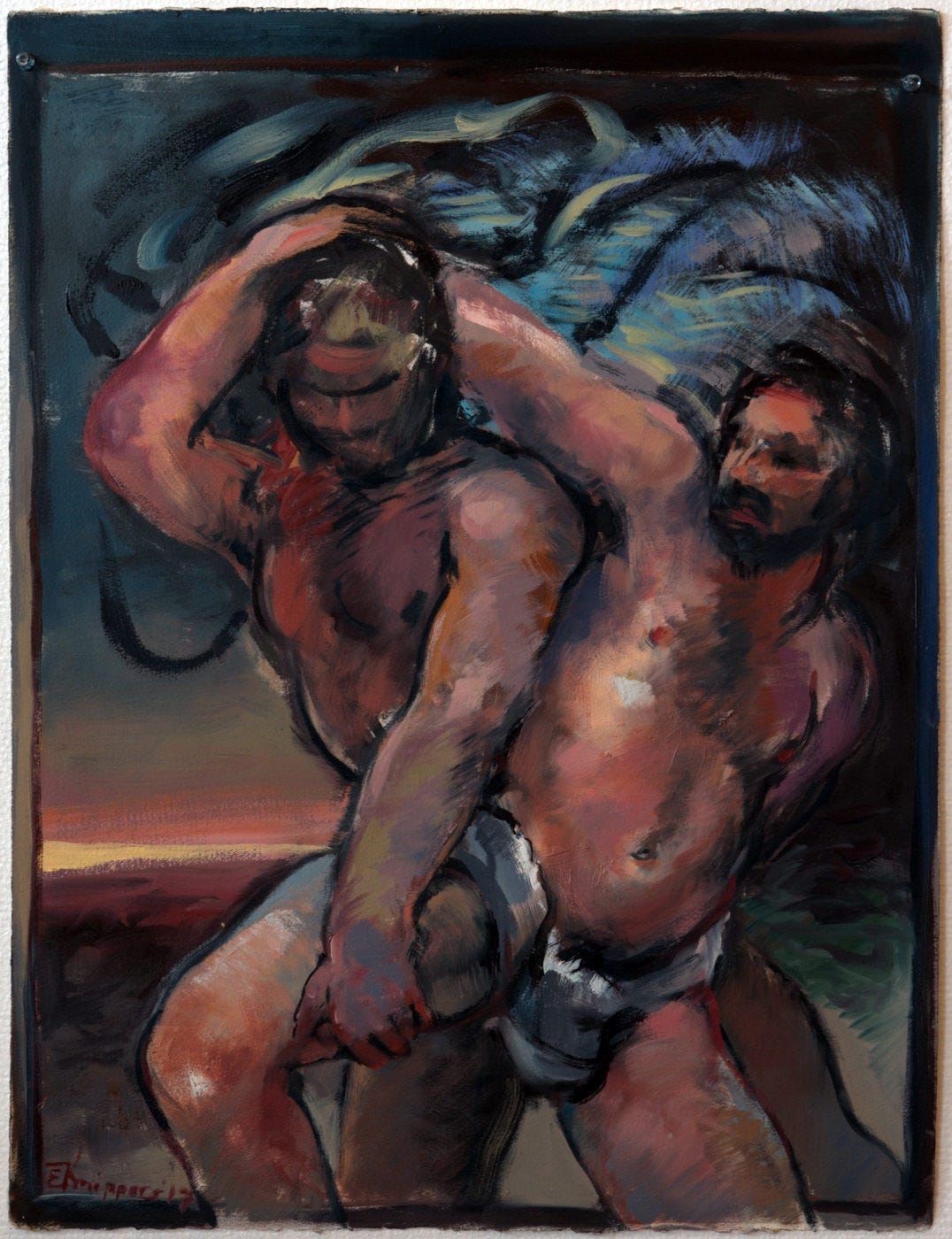
Edward Knippers
Some respond like the Pharaoh whose heart was hardened against Moses; he and his hosts were cast like stones into the sea. Some respond like the king of Nineveh who repented in sackcloth and ashes; he and his city were spared the impending judgment. Some respond like Jonah, who fled from God to Tarshish, but after being recovered from the sea went obediently to Nineveh. Some respond like Paul, who (against his master Gamaliel’s advice) helped with the stoning of Stephen, but afterward endured a stoning and all manner of abuse that he might proclaim Jesus, the great Provocation, to the sea of nations.
Provocation upon provocation! For men must wrestle with God, as God has wrestled with men. Which means also: Israel must wrestle with the church, and the church with Israel; on which more in part two of “Zionism in Christian Perspective.”
Excellent. To me, the most cogent thing any Christian has said about it. I look forward to Part Two.
Thank you, Douglas. Much food for thought. As an Eastern Orthodox Christian (Antiochian), I must ask if you have consulted any of our saints and scholars on this topic? I can think of nothing recent, but perhaps in earlier centuries? I will do some homework….