
The Lazarus Effect
Zionism in Christian Perspective, Part Four

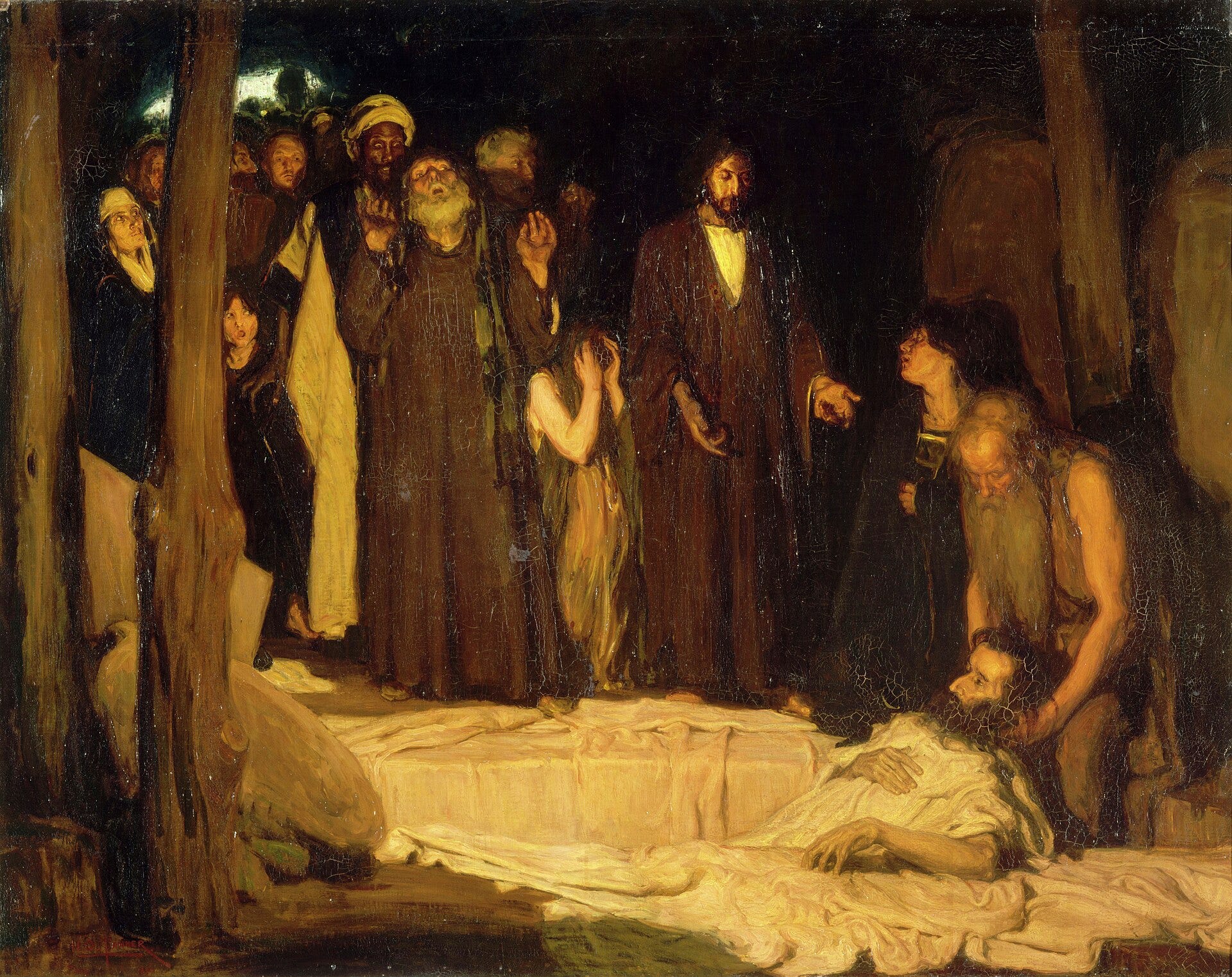
Tanner

Yisrael. He wrestles with God.
Yerushalayim. Seat of the King of Righteousness who blessed Abraham. City of David and site of the temple, sign of a new Eden. The ring in which the wrestling takes place and the victory is won by David’s greater son.
Yeshua. The LORD saves. “On the mountain of the LORD it will be provided” and, lo, it has been provided. Therefore his name has been carried from Jerusalem to the ends of the earth. A righteous remnant among the sons of Jacob began the mission. Gentiles joined to them have carried it through. But who will finish it?
Yom Adonai. The day of the LORD, a “great and terrible day” on which all the world will wrestle with God. For Israel, a day on which Golgotha will be revisited.
Thus says the LORD, who stretched out the heavens and founded the earth and formed the spirit of man within him: “Lo, I am about to make Jerusalem a cup of reeling to all the peoples round about. . . On that day I will make Jerusalem a heavy stone for all the peoples; all who lift it shall grievously hurt themselves. . . I will make the clans of Judah like a blazing pot in the midst of wood, like a flaming torch among sheaves; and they shall devour to the right and to the left all the peoples round about, while Jerusalem shall still be inhabited in its place. . . And I will pour out on the house of David and the inhabitants of Jerusalem a spirit of compassion and supplication, so that, when they look on him whom they have pierced, they shall mourn for him, as one mourns for an only child, and weep bitterly over him, as one weeps over a first-born.
“It is finished,” cried Yeshua from his cross, the cross by which he made peace between God and man. But this peace was not won without cost, and will not be realized without more pain. He wept over Jerusalem, and Jerusalem shall weep over him on the day of the LORD. The verdict against him will be overturned by the men of Judah, as it has already been overturned by their God.
That, in cryptic outline, is biblical Zionism, Christianly conceived. It is neither the political Zionism of Herzl, which failed to anticipate the Arab problem and has failed to solve it, nor the spiritual Zionism of those who look for a rejuvenated Israel to be the light of the world without reference to Jesus, or perchance by some belated admiration of the man as a neglected prophet. It is a robust Zionism that is not divided between the political and the spiritual and does not stumble over Jesus. It knows how to distinguish between the Jerusalem above and the Jerusalem below, but it neglects neither, for the two are bound together in him, just as the Jew and the gentile are bound together in him.
In the Jerusalem above, which is the church from Jews and gentiles, men are “not contending against flesh and blood, but against the principalities, against the powers, against the world rulers of this present darkness, against the spiritual hosts of wickedness in the heavenly places,” including those that have infiltrated the church itself, seeking per impossibile its destruction. In the Jerusalem below, men are contending against flesh and blood, especially now that Jews are back in Jerusalem, a thorn in the side of their neighbours and of the whole world, producing a boil that must and will be lanced. This latter contending is also spiritual, however. For the greater part of Israel is still wrestling with God and with God’s Christ, whom it has not yet recognized; which has forced the church to wrestle anew with Israel, exposing spiritual fault-lines of its own.1
St Paul foresaw these things, just as he foresaw the coming of the man of lawlessness who will unite the world against both Israel and the church. To gentiles in the church, he addresses himself directly and frankly:
Now I am speaking to you gentiles. Inasmuch then as I am an apostle to the gentiles, I magnify my ministry in order to make my fellow Jews jealous, and thus save some of them. For if their rejection means the reconciliation of the world, what will their acceptance mean but life from the dead? If the dough offered as first fruits is holy, so is the whole lump; and if the root is holy, so are the branches.
Who then are those who condemn the Jew if he is not a Christian? They do not speak with Paul. Paul speaks of the resurrection of his people, the Hebrew people. He speaks also of the resurrection of the church through the accession of Jews to the church, a point to which we will return in conclusion. But how, meanwhile, shall we connect this biblical Zionism, which is a both/and kind of business, to the political Zionism against which so many rail, including many Christians?
We will not do so by pursuing an analysis of the phenomena by which Jerusalem is indeed becoming a cup of reeling and the clans of Judah a heavy stone. We will consider rather the millennial constructs in which Zionism is couched. For all Zionism aspires to millennial peace.
Millennial Conceptions and Misconceptions
That the messianic age will produce a long reign of peace is a prophetic staple. Just as David defeated the enemies of Israel and Solomon consolidated the position of Israel among the nations, so likewise the anointed one who comes at the end of the present age. By the power of God, he will do all that David and Solomon have done and still more, for his kingdom will extend to the ends of the earth. The presence of God will be manifest to all peoples and through his Christ he will reign over the nations. Wars will cease and the lion lie down with the lamb. Men will seek after the God of Israel and learn to obey his law. His people Israel will be regathered from the four corners of the earth, enjoying full and secure possession of the promised land. The institutions requisite to life in the land under his royal priesthood will be restored, purified, and unified. There will be a resurrection of the righteous dead, that men of all ages may enjoy their reward together with him. In due course, by a miracle exceeding the first creation, there will be a regeneration of all things, such that the entire cosmos redounds eternally to the glory of God.
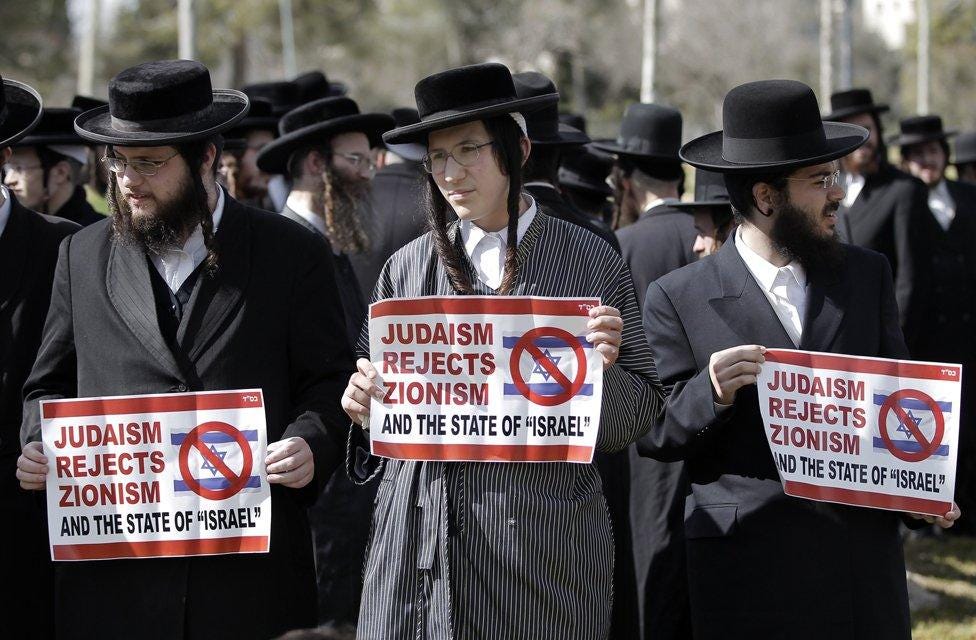
The religious Jew who believes all this, as Jesus himself did, is determined to prepare for the coming of the messiah and his kingdom. This Jew may or may not be supportive of the current State of Israel. If not, he may even adopt an anti-Zionist stance, for he is thinking of Zionism as a strictly political movement, subject to the fate of all political movements. He might even say, “If we’re sent into exile we should remain in exile. We have to trust God and wait for Ha-Mashiach.”
source
The religious Jew of either persuasion is what Christians would call a premillennialist. Messiah comes first, then the messianic reign of peace. What is disputed is whether or not Jews ought, pro tempore, to organize themselves politically in their ancient homeland as a means of preparation.
The secular Jew, who is doubtful about the prophets, may also be a Zionist or an anti-Zionist. If a Zionist, he is ready to establish and defend a modern state devoted to the welfare of Jews, something he regards both as a right and as a necessity. No doubt he wishes that his people had heeded the warning of Moses Hess, who in the mid-nineteenth century predicted that a hard blow was going to fall, a blow that would shake Europe’s “emancipated” and cultured Jewry to its core and cause many to seek refuge in Palestine. Alas, they did not do that soon enough to avoid the holocaust. And the holocaust, he thinks, underscores the difficulty in maintaining a biblically based religion. Like Herzl or Ginsberg, this Jew is a secularist, unbelieving sort of Jew. If he has millennial dreams, they are troubled by memory of the holocaust, to which he can summon no convincing answer and which he cannot be confident will never be repeated. He is not a messianist, and because of the holocaust he cannot be a utopian. Still, he may do his best to seek peace and pursue it.2
In the Christian sphere we encounter three millennial constructs, each of which attempts in some fashion to take account of the opening verses of Revelation 20, verses that recapitulate and transform the prophetic tradition by identifying both the foe and the saviour, and by situating the faithful between them, in tribulation and patient endurance, as those reigning with the latter:
Then I saw an angel coming down from heaven, holding in his hand the key of the bottomless pit and a great chain. And he seized the dragon, that ancient serpent, who is the Devil and Satan, and bound him for a thousand years, and threw him into the pit, and shut it and sealed it over him, that he should deceive the nations no more, till the thousand years were ended. After that he must be loosed for a little while.
Then I saw thrones, and seated on them were those to whom judgment was committed. Also I saw the souls of those who had been beheaded for their testimony to Jesus and for the word of God, and who had not worshiped the beast or its image and had not received its mark on their foreheads or their hands. They came to life, and reigned with Christ a thousand years. The rest of the dead did not come to life until the thousand years were ended.
The three constructs are distinguished by prefixes that differently position this millennial reign of Christ and the saints relative to his parousia or royal appearance. Pre-millennialism has the parousia preceding and inaugurating the age of justice and peace. Post-millennialism places it at the climax of that age, as if in reward for it. The inaptly named a-millennialism does the same, but does not look for the age of justice and peace in the future; that is, in some new configuration of secular life still to be achieved. Rather, it finds it now, like a treasure buried in the field, among those who do not worship the beast and its image; these are they who reign with Christ. The new configuration of things that will follow the parousia belongs to the life of the world of come, not to life in the world we know.
Premillennialism appears first among the fathers, but soon gives way to amillennialism. Postmillennialism is a much later phenomenon, traceable to Joachim in the twelfth century, gaining ground among protestants from the sixteenth. All three constructs were deracinated by the men of the Enlightenment, who expected no parousia. Something like postmillennialism then prevailed, with the return of Christ standing as a cipher for some future perfection of the race to be achieved through the advance of reason and science. In The New Atlantis Francis Bacon had already offered an aggiornamento of the Apocalypse, keeping one eye on the dangers of the scientific age and the other on its coming triumphs. He even hinted at a new and more enlightened kind of Judaism, as of Christianity, that could work together in harmony.
But how do these three constructs inform Zionism in the Christian sphere, where it is at once political and spiritual? The first, championed today mainly by evangelicals, cultivates determination to prepare for the parousia and for the peace afterward to be enjoyed. The regathering of Jews to Jerusalem, where they will be confronted by their need for the messiah they spurned, is willed by God as a precondition for the parousia. This necessitates the creation of an Israeli state and has produced such. Its existence will eventually lead to a war with the nations, under the direction of antichrist, before Jesus appears to rescue Israel and to judge the nations gathered against it, who are also to be confronted in their refusal of the gospel and apostasy from Christ. This construct, which is built around a literal interpretation of biblical prophecy, tends to philo-Semitism. The Jews will in the end be converted in large numbers. The nations, on the other hand, will continue to fall away in large numbers. Support meanwhile for Jews and their state need not be uncritical, but support there should be.3
The second, whose champions are generally found among the heirs of Calvin, though Calvin himself did not deploy these categories, may or may not encourage the Zionist enterprise as a means to the end of millennial peace. Where a dual covenant theology comes into play, positing that Jews and gentiles have separate arrangements with God, Zionism is likely. Here, however, attempts to convert Jews are frowned upon. Where dual covenant theology does not come into play, the postmillennialist may be decidedly anti-Zionist, perceiving the Israeli state as an impediment to world peace.4
The third construct, which owes much to Augustine and is mainstream Catholic doctrine, recognizes Israel as a covenanted people with an ancestral homeland, to which by divine providence it has lately been permitted to return. It respects the fact that a national polity is required, though the relation of that polity to divine purposes in history is said to be shrouded in mystery. The new Israeli state does not fall within the covenant per se, or enjoy divine sanction. Nor are there separate covenants for Jews and Christians, but rather a single covenant that began with Jews and now, through the church, embraces gentiles as well. That covenant continues to underwrite the promises made to Jews, but it does so through Jesus, in whose blood it has been ratified. So here there is some ambivalence about Zionism, a sort of Gamaliel-like “wait and see” approach, combined with a desire that Jews should, in their own way and time, discover Jesus.
As for the parousia, it will certainly come in its time, before which there will a crescendo of quakes and disasters in world affairs, and persecutions of Jew and Christian alike. Amillennialism and premillennialism do not differ much on that score. Their differences concern only the period intermediate between the parousia and the regeneration of all things, which the premillennialist thinks very long because he associates it with the second paragraph in the quotation above from Revelation 20. The amillennialist supposes it to be quite brief, because he reads the second paragraph as a retelling of the first. The first shows how things look from the standpoint of the ascended Lord and the church triumphant; it corresponds to Revelation 4. The second shows how they appear in the experience of the church militant; it corresponds to Revelation 5 and following.
But here we must mention a fourth construct, superficially akin to amillennialism but really a form of postmillennialism. It is the construct created by Catholic anti-Zionists in support of their closed supersessionism. It does not view the present age, simultaneously, through the two opposite lenses of Revelation 20 or, per chapter 1, of the eucharist itself. It views it rather in terms of successive eras: the triumphs of Christendom, which followed the sufferings of the imperial persecutions; and the triumphs of the new Christendom that will follow the modernist persecutions. On this approach there is a preliminary christological cycle of suffering and glory, and a subsequent Mariological cycle. It is Mary who warns of modernism and its consequences, and Mary who will see to it that the church crushes the head of the serpent a second time, and still more definitively.
Readers of my books may guess how sorely tempted I am at this point to revive, this time in properly Catholic form, my critique of ascension theologies that deflect from Christ to Mary instead of from Mary to Christ. Ironically, it is this very reflex that binds hard supersessionism to its arch-enemy, modernism, such that neither is able to grasp the accomplishments of the second Vatican council. But I must stay on topic, remarking only the link between this pseudo-Marian millennialism and the fourth construct’s anti-Zionism, which as such is not Marian at all. It is rather a falsification of her magnificat at its conclusion:
He has helped his servant Israel,
in remembrance of his mercy,
as he spoke to our fathers,
to Abraham and to his posterity for ever.
In this falsification, or rather expropriation, Abraham’s historic posterity is rejected forever.
Matthew Tsakanikas of Christendom College, for example, has been insisting that Christ and Christians are the only seed of Abraham; moreover, that Christ himself is the only “land of promise” and that what Christians used to call the Holy Land was never meant to be anything more than a pedagogical device to lead men to Christ. Those who have not come to Christ cannot reclaim it. It is destined now to be trod underfoot by the nations until the mystical body of Christ is complete. After that, it will not be restored. Rather, none will have need of it, for those who attain to life in Christ will be translated to heaven. Meanwhile, support for Zionism is nothing short of antichristic. The land is Christ and Christ is the land. Therefore any interest in the land promised, the land where Christ himself walked, is a denial of Christ. And who has that interest? Jews! Antichristic Jews and their antichristic sympathizers. Genocidal Jews, who persecute their Christian and Muslim neighbours. Child-killing Jews.
That such an argument, complete with blood-libel, should still exist in Christian circles is something I would myself call antichristic. Among other theological errors, it carries to an extreme the nature/grace dualism rejected in part one.5 More importantly, it belongs to a scheme that is eschatologically deceptive, one that pins Christian hope to the arrival of a new Christendom that God has not promised and to a pharisaical form of Catholicism, fervently but misguidedly Marian, that is supposed to prepare the way for it. For both reasons, it is not only anti-Zionist but anti-Semitic. It has no place for the Israelite, whether outside the church or within it. It works with a deracinated image of both Jesus and Mary; hence it can describe the Christian as the true Jew and the actual Jew as a false Jew.
According to Tsakanikas, “there is no longer a divine mandate—since Christ’s Ascension and the destruction of the Second Temple—for Jewish Zionists to take Palestine.”6 But this is a half-truth in service of a lie. What Christian will deny that the victorious Lord Jesus, who rose from the dead on the third day, ascended into heaven, and is seated at the right hand of the Father, has already taken authority over the land of his birth and every other land with it? Were it not so, he could hardly command his disciples to go into all the world and proclaim the good news of his kingdom to the peoples of every nation. This may tell us that we should not follow the bloody-minded monk, Radulph, into Jewish ghettos to slaughter Jews, who also belong to Christ. But does it tell Jews whether or not to follow Fr Ratisbonne (the Jesuit convert who founded a convent in Jerusalem thirty years before the first Zionist colony) into the Holy Land? Does it tell them they ought not to found a state there even after the holocaust?
The first temple was lost in punishment for sins and the second temple likewise, as Jews well know. God had told them to build the second, but he himself built the third. Through the incarnation he became the third, laying the foundation of a living and eternal temple that will never need replacing. The kind of Zionism that hopes to restore the status quo ante is not a Zionism Christians can support. Nor can they support the kind of Zionism that thinks to do without a temple, so long as it holds Jerusalem. That does not mean, however, that Christians cannot support Zionism at all or that it must object to an Israeli state. It does not imply that the establishment of Jews in Jerusalem can only falsify the gospel of Jesus. It does not cast the least shadow of doubt on the council that issued Nostra Aetate. It in no way justifies those who continue to drive a wedge between the Jew and Jesus by way of their blatant anti-Semitism.
The saeculum exists, by the grace of God, as a time of invitation and an hour of decision, for the Jew first and also for the Greek. It exists, according to Paul, for the Jew first and for the Jew again last. The Jew has stumbled before God, but he has not fallen from God’s sight or care. God has not passed him by, as if he were the Samaritan in the ditch. The lie being serviced by supposedly “theological” anti-Zionists, who are in truth anti-Semites,7 is not primarily a lie against Israel or Judah, but a lie against God. It is a diabolical denial of the faithfulness of God, who has by no means rejected his people Israel. He has not abandoned them forever to what, through Hosea, he called their harlotry. What did Hosea, whom God instructed to marry a harlot, actually say to them?
For the children of Israel shall dwell many days without king or prince, without sacrifice or pillar, without ephod or teraphim. Afterward the children of Israel shall return and seek the Lord their God, and David their king; and they shall come in fear to the Lord and to his goodness in the latter days. . .
I will heal their faithlessness;
I will love them freely,
for my anger has turned from them.
I will be as the dew to Israel;
he shall blossom as the lily,
he shall strike root as the poplar;
his shoots shall spread out;
his beauty shall be like the olive,
and his fragrance like Lebanon.
Lebanon today is far from fragrant, politically or religiously. Israel as yet is far from faithful, certain signs of spring notwithstanding. But the Christian can and should support the kind of Zionism Hosea has in view. All that he requires for that is faith in the faithfulness of God.
Gamaliel Again
We come full circle, then, to where we began, to the wisdom of Gamaliel. If the modern Israeli enterprise is of men only, it will fail, even as the Bar Kokhba revolt failed. If it is not of God, it enjoys no guarantee except eventual failure. What was said before will be said again: “They made kings, but not through me. They set up princes, but without my knowledge. With their silver and gold they made idols for their own destruction.” If it is of God, on the other hand, one stands in opposition to it at one’s peril, for God does not fail. Many may conspire together against it and lay siege to it; still, it will not fall. Antichrist may deceive and seduce it, drawing it to his side for a season; yet he will not in the end be able to hold it there.8
But whether of men or of God, Israel faces a seemingly intractable dilemma. Being a polity primarily for Jews, it cannot leave divine election out of account. Without election there is no Jew. Neither can it presume on God to bless its own programme or agenda. If it seeks merely its own profit, if it ignores what it knows of the law of God, if it does evil that good may come—even the good of its own survival—it will be punished by defeat. Those who try to resolve this dilemma by regarding the modern state itself as messianic only fall into a new form of idolatry. An independent Jewish state may be a very good thing, but it can neither substitute for, nor usher in, the kingdom of God.9
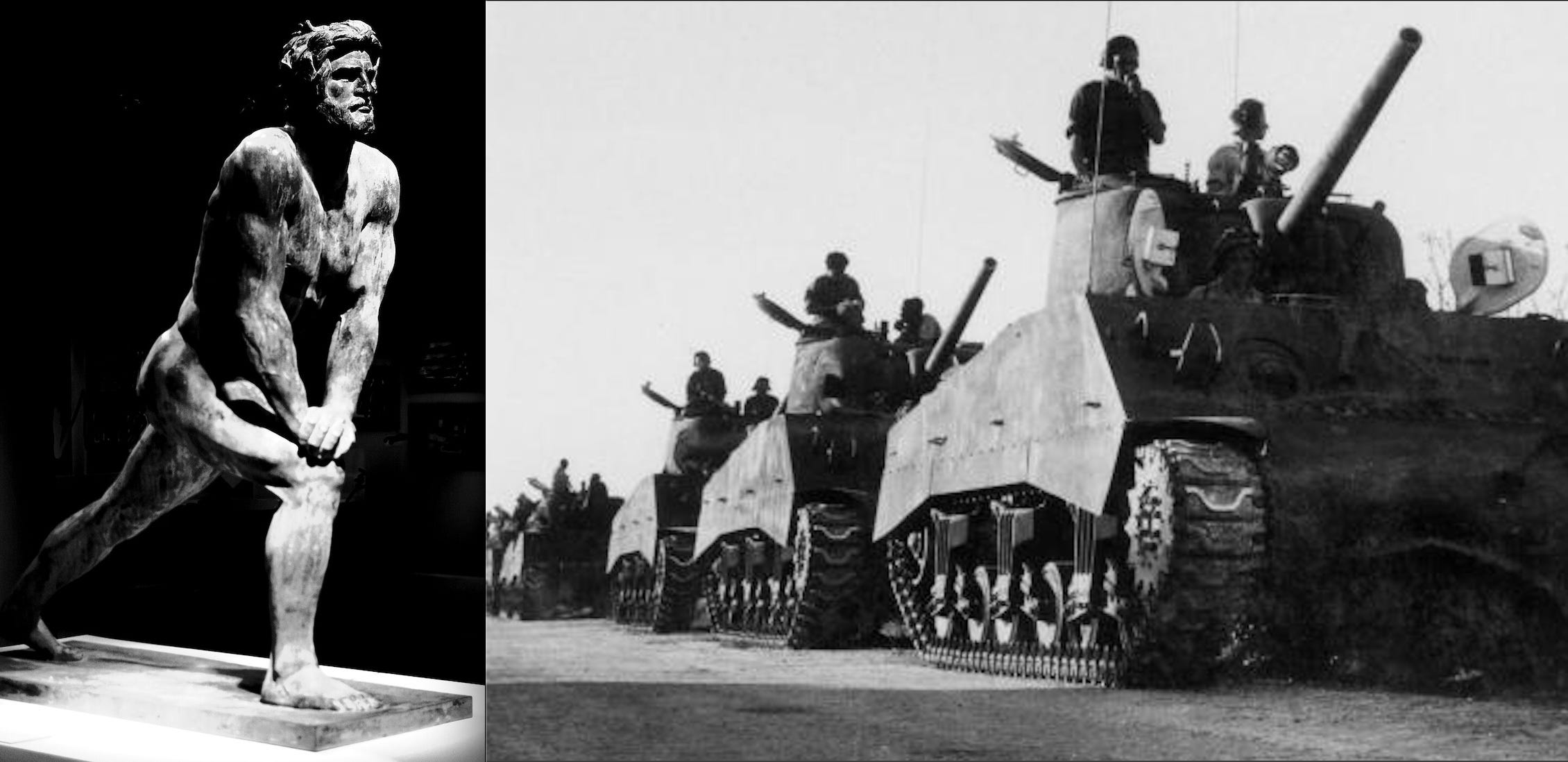
Why then does it exist? It exists because Israel is being forced again—collectively, for its election is collective—to wrestle with God. It exists also that others, because of it, should be forced to wrestle with God. It exists because God wills it to be, not only confounded, but confounding. It is not a mere accident of history that modern Israel has set the world ablaze. It was prophesied that it should do so.
There are those gentile Christians, as we have seen, who do not grasp what the Catechism of the Catholic Church says at §674: “The glorious Messiah’s coming is suspended at every moment of history until his recognition by ‘all Israel,’ for ‘a hardening has come upon part of Israel’ in their ‘unbelief’ toward Jesus.” They do not see that the church triumphant is not a future reality in the present age, but a present communion of saints and martyrs. Hence they are given to anti-Semitism, repelling rather than attracting Jews. They are not mindful of Augustine’s concluding advice in Adversus Iudaeos:
Dearly beloved, whether the Jews receive these divine testimonies with joy or with indignation, nevertheless, when we can, let us proclaim them with great love for the Jews. Let us not proudly glory against the broken branches; let us rather reflect by whose grace it is, and by much mercy, and on what root, we have been ingrafted. Then, not savouring of pride, but with a deep sense of humility, not insulting with presumption, but rejoicing with trembling, let us say: ‘Come you and let us walk in the light of the Lord,’ because his ‘name is great among the gentiles.’
Neither do they partake of the spirit of Paul, who is so intent on the salvation of his people that he adopts before God the posture of Moses. “I could wish that I myself were accursed and cut off from Christ for the sake of my brethren, my kinsmen by race.”10 They partake rather of the spirit of the Enlightenment, with which they fancy themselves in competition. That is the spirit already repudiated in the Tridentine catechism (AD 1566), which pointed out that any supposed justification for persecution of the Jew on account of Jesus, who gave his life for his people, was impossible. Guilt for his death, it acknowledges, is more enormous in us than in the Jews, since, if they had known what they were doing they would never have crucified the Lord of Glory, “while we, on the contrary, professing to know Him, yet denying Him by our actions, seem in some sort to lay violent hands on him.”11
Christianity maintains that the Mosaic form of the covenant was instituted by God for the purpose of preparing the way before his Christ. It does not deny that the fragments left over, so to say, after the coming of Christ and the demise of the second temple, can continue to serve that purpose for the Jew who does not yet recognize Jesus as the Christ. It only invites the Jew, with the Greek, to come to Christ and enjoy the perfect law of liberty. It does not reject the Jew or the corporate election of the Hebrew people. It teaches that God loves the Jew for Abraham’s sake, and that the gentile Christian must learn to love the Jew for Christ’s sake.
Does he love the Jew for Christ’s sake? Then how can he tell the Jew not to love Zion in the way, from the days of David, he has always loved Zion? How can he tell him to be content to take his chances in the cities from which he has fled to Jerusalem, the cities in which to this very day Jew-hatred abounds? Jew-hatred is not a consequence of Zionism! Jew-hatred we have always had with us. If Jew-hatred today is a consequence of Zionism, of what is the hatred of Christians a consequence?12
Jerome and Chrysostom—yes, even those cranky opponents of the rabbinic Judaism that tried to gather up the fragments—took as granted Paul’s talk of a large-scale conversion of the Jews as something that would eventually happen. Moreover, they believed that it would happen more or less simultaneously with the great apostasy among Christians foreseen by Jesus and Paul for the latter days. In that light, we must ask whether the vociferous opposition to the modern Israeli project, not only by secularizing Christians in thrall to the deceiving influence of corporate and social media, but also by soi-disant traditionalists bent on reviving the anti-Semitic excesses of an earlier period, is itself a form of apostasy.
Now, both will object that, when it comes to deceiving influences, “the Israel lobby” is no slouch. Perhaps so. In America, at least, lobbying seems to be the prevalent form of politics. I will only reply with Elias Friedman that “political Zionism will remain an ambiguous sign until the admission of the Jews [to the church] has occurred,” and that what ought to concern us is not so much the successes or failures of political Zionism as that “deep current of messianic spirituality” which has coursed “through the Zionist enterprise from its onset.”13
We have not come all this way merely to say that, however, or simply to take the “wait and see” approach of Gamaliel. What is not of God will fail, yes; what is of God will succeed. So let us be prudent, by all means, and not be found standing in the way of God. And let us never presume to say that we are “the true Jews,” but only that a Jew is never more truly a son of Abraham than when a Christian. Some say that Gamaliel himself became a Christian, a pleasant thought. Yet we must turn once more to his student, Paul, to conduct us to our proper conclusion.
Romans Revisited
I have not said that the Christian must love Zionism. Zionism is a sure sign of trouble. I have said that he must love Zion and that he ought to respect Zionism, however resistant he may be to particular Zionist policies or practices, whether in Israel or in his own country. Those convinced that Zionism, and so also the State of Israel, has a role to play—perhaps multiple, conflicting roles—in the fulfillment of ancient prophecies are not mistaken. Those who suspect that it will prove an instrument in the fulfillment of Paul’s expectations for the salvation of “all Israel” are not mistaken either.14 But perhaps you will reply that, according to Paul, the Christian is to love the Jerusalem that is above, the Jerusalem that is free. My rejoinder will be: then let him love also the Jerusalem that is below, by which it is named. Or perhaps you will quote this to me, from Paul’s letter to the Colossians:
If then you have been raised with Christ, seek the things that are above, where Christ is, seated at the right hand of God. Set your minds on things that are above, not on things that are on earth. For you have died, and your life is hid with Christ in God. When Christ who is our life appears, then you also will appear with him in glory.
Amen, I say. And where will he appear? He will appear in the Jerusalem below, the Jerusalem that is not free, that it may become free. This Jerusalem the Christian has always loved. He has loved it because Jesus walked its streets, prayed in its gardens, and wept over its fate.15 He has loved it because he has believed the prophetic word that Jesus will return to it. He has loved it because the kin of Jesus, after the flesh, were promised it. Today they require it, as Jesus once required the donkey stabled there, though they do not know all the reasons why they require it.
Jesus required the donkey because he was entering Jerusalem as a conqueror. How a conqueror? He was entering as one determined to take on himself the fate of his people, the fate he had prophesied—crucifixion by Rome, whose emperors loved such a procession to mark their triumphs. And what happened to his own people after they delivered him up for crucifixion? Something they had not anticipated. He had assumed the fate of his rebellious generation. They in turn, for many generations, would assume his fate. Friedman again:
As he walked slowly across the stage of history, the Jew took on an uncanny resemblance to Jesus: beaten, spat upon, mocked, derided. . . The people of the Messiah had to be molded into the image of their Messiah in order to learn who the true Messiah was.16
But are they learning, you ask? Many no longer look for the messiah. They have reverted to their condition in the days of Samuel, desiring to be nothing more than a nation like other nations, though they know deep down that this is not possible. There is a reverse side, however, to this coin of secularization. Talmudic Judaism, built in and for the diaspora, is losing its hold on the ordinary Israeli, despite the power its rabbis wield in a divided Knesset. Having come back to the land, moreover, they are being confronted in a new way by Jesus, whose footsteps they stumble across at every turn. They are being confronted anew by their own scriptures, among whose famous sites they now live. They are also becoming disenchanted with political Zionism, which, being spiritually hollow, is suffering the same fractious fate today as it did in the days of John and Jesus.17 On Friedman’s view, God in his providence has been driving the Jews into what Edward Flannery called “a blind alley of grace,” where they can and will discover something of the messiah in advance of his return.18
Today’s Zionism, in other words, the human work of regathering Jews to the land for their own protection, is leading providentially to a divine work of spiritual re-grafting into the tree of life that Jesus made of his own cross. This, their third return to the promised land, is a kind of resurrection on the third day.19 It is playing a role in Israel’s unintended imitation of the recapitulating work of Christ. This imitatio, though it has entailed the severest of severe mercies, is a form of grace that when complete will answer, as nothing else can, even to the holocaust.
Rabbinism is anti-Christian; the Jewish people has ever lived in imitation of Christ. What is more, in Jewish martyrdom Jesus himself is martyred. This corresponds well with the intuition of the Jewish sages that God shares his people’s suffering. The accession of Jewry to the faith, far from being a break in Jewish history, will be its consummation; it will bring the Jew to the full consciousness of the sense of his own identity and existence. Once faith is given, Jewry will be transformed into a powerhouse of spiritual motivation, sufficient to bring about the “resurrection of the dead", the return to the faith of lapsed Gentility. Jews have suffered and continue to suffer in view of the role that they are destined to play in the salvation history of mankind.20
Jesus warned them that they would suffer, but not forever. “For great distress shall be upon the earth and wrath upon this people; they will fall by the edge of the sword, and be led captive among all nations; and Jerusalem will be trodden down by the Gentiles, until the times of the Gentiles are fulfilled.”
The gentiles, for their part, like to think that the times will roll on without end, though in truth they have become more and more fearful that their days are numbered. They are indeed numbered, and fast running out. But the conclusion to which we are coming is a more positive one than that. It is the conclusion Paul anticipated when he wrote to the Romans that, when the Jewish people had received life from the dead, that would prove redemptive for the church as well.
I confess to some uncertainty as to his exact meaning when he writes: “Now if their trespass means riches for the world, and if their failure means riches for the Gentiles, how much more will their full inclusion mean? . . . For if their rejection means the reconciliation of the world, what will their acceptance mean but life from the dead?” But the basic logic is not difficult. The last-minute rejection of Jesus, and refusal of the apostolic witness to Jesus in his own resurrection, sent the gospel out into the highways and byways of the gentile world, bringing many to salvation. And if God could work that incalculable good out of the evil they did and the evils they suffered, how much more good will he work from their repentance, from their joining to the righteous remnant who did not abandon Jesus?
Jerome and Chrysostom were not the only ones who read Paul’s “life from the dead” as referring, not merely to the Jews, but to the church, which at the time of the restoration of Israel would be suffering grievously from the great apostasy among the gentiles. Do gentiles imagine that they are better than Jews? If so, they have listened to Chrysostom at his worst, not at his best. They have also neglected the rule of theology which maintains that Jesus’ relation to the world is the analogue of his relation to Israel, and that it must be with the church in the world as it was with Jesus in Jerusalem. Was there a great apostasy then and there, in the microcosm of Israel? So there will be a great apostasy here and now, in the macrocosm of the nations. And the church, if it is to survive this apostasy, will have to lean on the Jews whom Jesus has recalled to himself.21 Hence we are warned by Paul, as we were warned by Jesus:
If some of the branches were broken off, and you, a wild olive shoot, were grafted in their place to share the richness of the olive tree, do not boast over the branches. If you do boast, remember it is not you that support the root, but the root that supports you. You will say, “Branches were broken off so that I might be grafted in.” That is true. They were broken off because of their unbelief, but you stand fast only through faith. So do not become proud, but stand in awe. For if God did not spare the natural branches, neither will he spare you.
The apostasy in question has been going on for a long while now. It is not slowing but accelerating. Friedman quotes Joseph Lémann: “One must be deaf not to hear the cracking of the branches. Great God! What a noise!” And J. H. Newman: “Indubitably, we have come to that pass.” The great apostasy has begun and the bonfire is being lit. But “against this moment,” writes Friedman, “God has held the Jews in reserve, to use the brilliant phrase of Duguet.”22
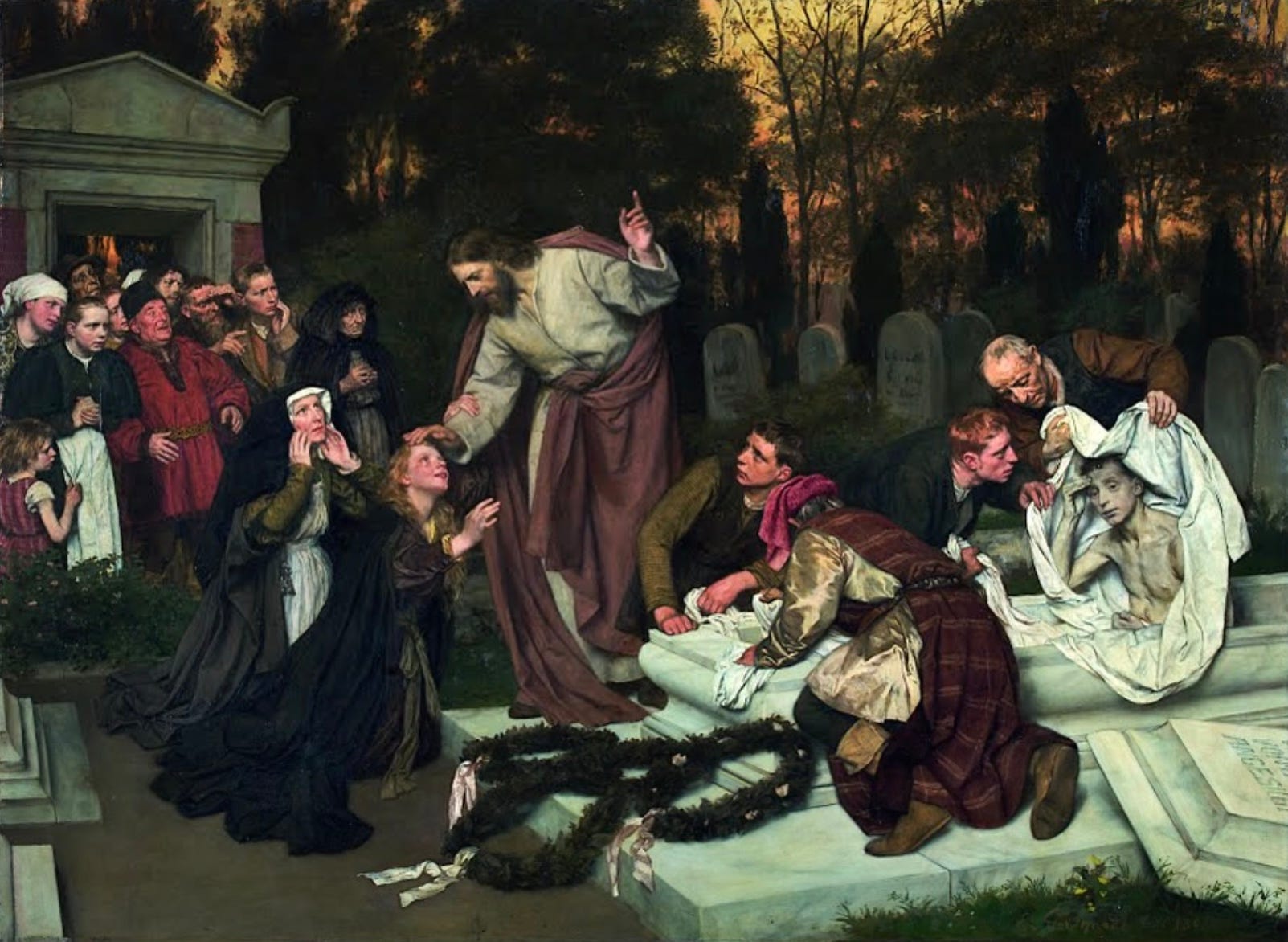
In this 1896 painting, Eduard von Gebhardt gets it right. The church must come out to greet Lazarus. By contrast, the SSPX gets it wrong in their schismatic declaration of faith, framed as it is by rejection of the old covenant and so also of the Jew. How does it begin? “In the Name of Our Lord Jesus Christ, divine Wisdom, the Word Incarnate, Who willed one sole religion, Who rendered the Old Covenant definitively null and void, Who founded one sole Church. . .” And how does it end? “Christendom is not a mere historical phenomenon, but the only order willed by God among men. It is not for the Church to conform herself to the world, but for the world to be transformed by the Church.” Their most recent schismatic action is a consequence of their dalliance with Marcion; so are their delusions about a new Christendom.23
In the midst of all the sound and fury outside the church—“Hamas, Hamas, Jews to the gas!”—and inside it as well, the most important thing to be said about Zionism from a Christian perspective is that, for all its flaws as a human enterprise, it signals an impending work of grace for the church—the church from Jews and gentiles which requires more Jews, not less Jews, and is destined to receive them.24 It is not the cause of, but it is a harbinger of, the Lazarus effect to which Paul points us; that is, to the strengthening of the church in its hour of need through the conversion of Jews.
In the list of dramatis personae et loci with which we began, we did not mention Lazarus. But Yisrael is Lazarus, or will be, because Yeshua is Adonai.
Then Jesus, deeply moved again, came to the tomb; it was a cave, and a stone lay upon it. Jesus said, “Take away the stone.” Martha, the sister of the dead man, said to him, “Lord, by this time there will be an odour, for he has been dead four days.” Jesus said to her, “Did I not tell you that if you would believe you would see the glory of God?” So they took away the stone. And Jesus lifted up his eyes and said, “Father, I thank thee that thou hast heard me. I knew that thou hearest me always, but I have said this on account of the people standing by, that they may believe that thou didst send me.” When he had said this, he cried with a loud voice, “Lazarus, come forth!” The dead man came out, his hands and feet bound with bandages, and his face wrapped with a cloth. Jesus said to them, “Unbind him, and let him go.”
In part three we rejected both supersessionist anti-Zionism and Zionist anti-supersessionism. We adopted a position different from both. Here there was most definitely a place for the Jew, as still beloved by God for father Abraham’s sake and, just so, still in receipt of promises made to Abraham. Yet the Jew was not excused from wrestling with Peter’s confession to Jesus, “You are the Christ, the son of the living God.” Nor was the Christian relieved of the responsibility to ponder the current situation of the Jew and his new state in just that light.
See Elias Friedman, Jewish Identity, chap. 15, esp. p. 155. The book can be perused online, but note that the pagination differs. I am much indebted to David Moss for introducing me to Friedman.
I say that premillennialism appears first, but of course I do not include the dispensationalist form of premillennialism that was invented by J. N. Darby in nineteenth-century England and popularized by the Scofield Bible in twentieth-century America, where it produced a new wave of Zionism among evangelicals. On Darby’s falsely comforting scheme, Christians will be “raptured” or gathered out from the nations prior to the reign of antichrist, with its great tribulation. Among those of that persuasion, some have drawn the conclusion that there is little to lose and much to gain by encouraging “apocalyptic” developments in world history. If one is looking for raw apocalypticism, however—to employ that word in its popular rather than its proper sense—Shia Mahdism should more than satisfy the appetite. Dispensationalism is not a creature of that kind. And while it remains influential in evangelical circles—Ambassador Huckaby comes to mind—many Christian Zionists are careful to distance themselves from it. Gerry McDermott, for example, suggests in Israel Matters that Lord Shaftesbury was neither a dispensationalist nor a premillennialist, and that the developments he encouraged had a more respectable lineage in Reformed postmillennialism. But Don Lewis, in The Christian Origins of Zionism, observes that Shaftesbury’s teacher, Edward Bickersteth, converted to premillennialism in 1835, though not to dispensationalism, and that Shaftesbury himself turned in premillennialist circles, despite the fact that some there were discrediting themselves through speculation about dates for Christ’s return.
Postmillennialism may even reduce to political activism. The unnamed authors of the 2025 Kairos document of the Palestinian Christian Initiative write that they “envision a future in which our world is free of war, death, sectarianism and tribalism, where the word of truth rises above the word of power, where legitimacy belongs to peace and justice.” In support of this utopian dream, they add: “We draw our hope from the Word of God and from the faith alive in our hearts, refusing to leave the shaping of the future to the voices of extremism, colonialism and supremacy.” Their own rhetoric, however, which is typical of BDS anti-Zionism, belies that claim. The faith and future in question are of a type no longer framed by the ascension and parousia, hence not properly eschatological at all.
For example, the equation of “land” with “Christ” effectively renders land, in any literal sense, irrelevant.
This appears in conversation with Lifesite, where the sort of thing I am criticizing seems to prevail. I do not suppose that it prevails at Christendom College, nor am I accusing Tsakanikas or anyone else of holding to all elements of it. It does exist, however, and it has quite understandably invited from André Villeneuve (co-founder of Catholic Voices for Israel) a proposal that the church return to the premillennialism of its earliest days. I am sympathetic, if the premillennialism in question is of the sophisticated kind propounded by Irenaeus (see my Ascension and Ecclesia, 59–65), but I think that solution unnecessary. For the problem we face here is not intrinsic to amillennialism, but only to the perverse form of it I am describing, a form that finds the reappearance of Jews in Jerusalem unthinkable and does not know what to say of these Jews except that they are carnal, Christ-killing Jews.
Their denials are unconvincing. They tar every Jew with the brush used in the Apocalypse for certain Jews in Philadelphia: “Behold, I will make those of the synagogue of Satan who say that they are Jews and are not, but lie—behold, I will make them come and bow down before your feet, and learn that I have loved you.” And since the speaker, Jesus, is now out of the Jews’ reach, they charge the latter with the slaughter of Palestinians instead, accepting Hamas propaganda at face value. They need this propaganda to be true in order to sustain their theological delusion. They need Israel to be defeated and humiliated before the Palestinian “Christ.”
Solovyov depicted this in his Short Tale, in the telling of which he puts the matter of circumcision to a different use than did Bacon. Peter Thiel and Sam Wolfe put it, perversely, to a different use yet. I will be publishing something soon on their own scheme of things.
There is of course no more need of that, nor any possibility of it, since God in Christ “has consigned all men to disobedience, that he may have mercy upon all.” The Jew, then, ought not to glory in his Jewishness, nor the gentile that he is not a Jew. Each must recognize God’s patience with the other, and so also with himself. The gentile must learn that the Jew has been permitted to be an enemy of God for the gentile’s sake, yet remains beloved by God “for the sake of his forefathers.” Genuine Christian thinking both about Israelites and about the land of Israel must begin here, allowing us to see subsequent developments in Judaism—especially its shift from pre-Christian Judaism, the original religion of exile, to rabbinic Judaism, the religion of the new exile—in both a positive and a negative light. Negatively, it may be conceded that the Christian and the Jew each had reason to regard the other as perfidious, that is, as a covenant-breaker: the one because he understood the Abrahamic covenant to have been ratified anew in the blood of Jesus and confirmed by God through the resurrection of Jesus; the other because he thought Jesus (though curiously not John) a blasphemer and refused to believe in his resurrection. Positively, it can be conceded that over the ensuing centuries Judaism has served to keep the Jewish people conscious of the covenant and engaged in covenantal life. It has served, as Augustine recognized, to prepare both Jews and Greeks to become Christians. What did Mary say, when pregnant with Jesus? “God has remembered his steadfast love and faithfulness to the house of Israel.” The Jew who knows and lives the scriptures, as she did, is always in danger of becoming pregnant with faith in Jesus. And what is the proper spirit of Christians, if not that of St Stephen? “As they were stoning Stephen, he prayed, ‘Lord Jesus, receive my spirit.’ And he knelt down and cried with a loud voice, ‘Lord, do not hold this sin against them.’”
1829 translation. In Nostra Aetate (1965) the fathers of the Second Vatican Council elaborated, rejecting the kind of supersessionism that makes a scapegoat of the Jew:
True, the Jewish authorities and those who followed their lead pressed for the death of Christ; still, what happened in His passion cannot be charged against all the Jews, without distinction, then alive, nor against the Jews of today. Although the Church is the new people of God, the Jews should not be presented as rejected or accursed by God, as if this followed from the Holy Scriptures. All should see to it, then, that in catechetical work or in the preaching of the word of God they do not teach anything that does not conform to the truth of the Gospel and the spirit of Christ. Furthermore, in her rejection of every persecution against any man, the Church, mindful of the patrimony she shares with the Jews and moved not by political reasons but by the Gospel’s spiritual love, decries hatred, persecutions, displays of anti-Semitism, directed against Jews at any time and by anyone.
From the archives of the Jewish Telegraph Agency, 30 December 1941: “The persecution of the Jews is not the concern of the Jews alone, but is also a Christian concern,” declared the Rt. Rev. Msgr. Fulton J. Sheen, in a broadcast over the National Broadcasting Company’s network, last night. “There is no such thing as anti-Semitism as such,” Msgr. Sheen said. “To be anti-Semitic is also to be anti-Christian. We must look upon the persecution of Jews and Christians today not as separate, unrelated cause[s], but [as] involving one another in some way because both are related to God.”
Jewish Identity, 132; 141. Friedman does not content himself with the vagary, “messianic spirituality,” and nor should we.
Pius X, on the other hand, was mistaken, when he said privately, “The Jews have not recognized our Lord; we therefore cannot recognize the Jewish people.” Or again, “We cannot prevent the Jews from going to Jerusalem, but we could never sanction it.” John Paul II, in a very public act, recognized the State of Israel in 1993, accompanying this deed with repentance for acts by Christians done in a contrary spirit.
“O Jerusalem, Jerusalem, killing the prophets and stoning those who are sent to you! How often would I have gathered your children together as a hen gathers her brood under her wings, and you would not! Behold, your house is forsaken and desolate. For I tell you, you will not see me again, until you say, ‘Blessed is he who comes in the name of the Lord.‘”
Jewish Identity, 124f.
So Friedman argues, especially in the final two chapters. He wrote forty years ago, but has the trajectory he describes altered substantially? His designation of Jewish identity in today’s Israel as “pre-Christian” seems over-optimistic, humanly speaking; but of course he is appealing to a work of God, not of man, the signs of which he attempts to describe. He is also striving for a new approach to the treatment of Jewish converts to Catholicism, encouraging the church to support them as Israelites, and to help them support one another, that they may in turn minister to those not yet converted. This work continues today in the organization he founded.
Ibid. 159; the reference is to the final page of an article by Flannery in The Bridge: A Yearbook of Judaeo-Christian Studies, 3 (1958): 301–24.
“Mystically speaking, Jewry as a whole was nailed to the cross and died under Hitler. ‘We all died in Auschwitz’ cried out that great soul A. J. Heschel, in the name of all the Jews of his time. On the third day, three years after the conclusion of hostilities in 1945, Jewry rose from the dead; the State of Israel was proclaimed.” (Jewish Identity 124; cf. chap. 2 of T. F. Torrance’s The Mediation of Christ, first published in 1983). Where Friedman has “three years,” I note, a millennial reference might be more apt. After two millennia in the grave, Jews are learning through their national renewal what it means to say that a thousand years is counted by the Lord as a single day or as a watch in the night.
Jewish Identity, 125.
Friedman at p. 130: “From the whole tenor of the passage it can be inferred that the ingrafting of the Jews and the retrenchment of the Gentiles are presented as parts of a simultaneous process. St. Jerome supports our exegesis: ‘Their sins occasioned the salvation of the Gentiles and again the incredulity of the Gentiles will occasion the conversion of Israel. You will find both in the Apostle Paul’ (Commentary on the Song of Songs, homily 1). St. John Chrysostom agrees: ‘Seeing the Gentiles abusing little by little their grace, God will recall a second time the Jews‘ (On the Epistle to the Romans, chap. 11). St. Thomas examines a number of alternative interpretations of the phrase ‘resurrection of the dead‘ to settle on the following opinion: ‘What, I say, will such an admission effectuate, if not that it bring the Gentiles back to life? The Gentiles would be the believers whose faith has grown cold; or even that the totality, deceived by the Antichrist, fall and are restored to their pristine fervour by the admission of the Jews’ (Commentary on Romans, 11:15). J. Lémann resumes the argument: ‘One must expect that the figure of the Messiah, at a given moment of history, [will] appear between two negations, the negation of the Jewish people, who do not want to recognize him and the negation of the Gentiles as an assembly of nations, who will have abandoned him, after having known him’ (La Question du Messie, p. 92). We are indebted to Lémann for the definition of the biblical expression ‘apostasy of the Gentiles’. It does not mean that all Gentile Christians will lose their faith. . . The apostasy of the Gentiles is synonymous with the collapse of Christendom, not with the disappearance of Christianity... Our question was: when, according to Scripture, is the accession of the Jews due to occur? Our answer is that it will take place simultaneously with the apostasy of the Gentiles.”
See 137–44; cf. my commentary on 2 Thessalonians, which on these matters dismayed certain readers who had been enjoying the commentary on 1 Thessalonians.
They naively imagine the ascended Lord sitting at a vanishing point far above the earth, with the church’s eucharist serving as a great ladder that reaches into the highest heaven, so that Christ be present on earth ordering all things through the church to his own glory. Mary too comes and goes, less frequently and by uncertain means, preparing those who belong to the church for their heavenly habitation. When all is in readiness, when sufficient numbers have bent the knee to Christ and his vicar, then will come a millennial age of peace, after which will occur the last judgment and the folding up of time and space into eternity. There is little room here for the new (renewed) heavens and earth of which the scriptures speak, and the fathers with them. There is no room for fulfillment of the promises to “old Israel,” whose members, if they wish to share in this, must abandon their carnal dreams and adopt what amounts to a Marcionite vision of the “new Israel.” Meanwhile, the church itself becomes carnal, thinking to rule the world until it vanishes away in the beatific vision.
That is a work, I suspect, that will provide new meaning to Jesus’ instruction to his disciples: “When they persecute you in one town, flee to the next; for truly, I say to you, you will not have gone through all the towns of Israel, before the Son of man comes.”
Wonderful, but so long that most readers will do as I did with it, skimming it. I applaud your knowledge and dedication, but you need to re - send these articles in ten or twelve installments.