
Corrupting the Katechon
An exercise in last things for readers of First Things (Part 1)

Wired
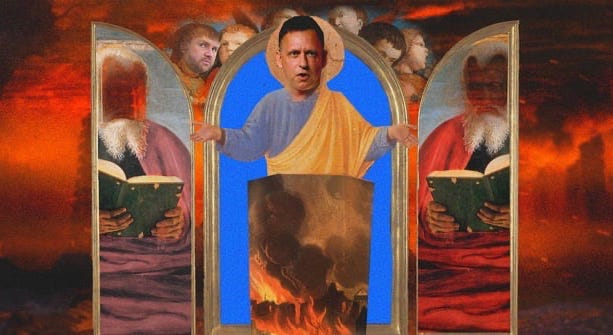
Who will restrain the restrainer? The concept, I mean, not the restrainer as such, for the concept has quite a life of its own. It is discussed today, in private and in public, by journalists and politicians, philosophers and venture capitalists.
Many will know that, from the Constantinian era to the end of Christendom, it was common to associate the katechōn, that mysterious restrainer of lawlessness referenced by Paul in 2 Thessalonians 2, with his talk in Romans 13 about rulers not bearing the sword in vain but executing divine wrath on the wrongdoer.
Some will know that it was the lapsed Catholic jurist, Carl Schmitt, who made the concept popular again in the days of the National Socialists, with whom he allied himself in 1933, parting ways with the theologian Erik Peterson, who in the same year became a Catholic convert.1
A few will know that the philosopher Giorgio Agamben has tried to wrest it away from both those men, generating quite a cottage industry in katechon talk among academics.
But who does not know that one of today’s wealthiest entrepreneurs and political influencers, Peter Thiel, is keenly interested in the subject, as he has been ever since the Austrian theologian, Wolfgang Palaver, introduced him to Schmitt’s ideas decades ago? Schmitt and Agamben remain important figures on his intellectual landscape, together with René Girard and others.
First Things platformed Thiel’s treatment of the subject last year, with co-author Sam Wolfe, in “Voyages to the End of the World,” the magazine’s second most popular article of 2025. Another helping has just been served up in “The Pope and the Antichrist,” which begins with the odd (and untrue) justification that no one else is talking about it.
Even those who know nothing of all this, however, if they know their Bible, will know that, by holding back “the mystery of lawlessness,” the katechon also holds back the appearance of the Man of Sin who is to come at the end of the age—until it doesn’t, of course. And they may have questions, some of which I hope to answer. For the second chapter of 2 Thessalonians, though little read in the churches and rarely read well, is the object of many ingenious misconstruals by those who do read it.
I trust my readers will forgive me for treating some of the misconstruals first. It would be rather anti-climactic to treat St Paul first and then move on to those who think they know better than he. That’s just the problem with modernity, isn’t it? It supposes that it’s always possible to move on, and that to do so is to make progress. Anyway, our own voyage will be a voyage backward from Peter Thiel to the Apostle Paul. Along the way we will learn a few things about what our modern apostles have been saying regarding the katechon, that shadowy figure situated alongside Christ and Antichrist.
The Tech Bro as Katechon
In “Voyages,” Thiel and Wolfe take us on a wild tour of works by Francis Bacon, Jonathan Swift, Alan Moore and Eiichiro Oda. That’s no ordinary itinerary! The first two stops, I must say, are in places that seem to me strangely altered; the latter two bring us to places to which I was happy to be introduced. The main question posed throughout is this: “Will science summon or suppress the Antichrist?”
It seems that science—I would say technology; it is a mistake to conflate the two—will do both. On the summon side, a case is made that it will give Antichrist almost supernatural powers to impress and coerce. On the suppress side, a case is made that, by exceeding Antichrist’s grasp, it will frustrate those powers. The suppress side is the favoured side, the katechonic side. In the right hands, technology can restrain Antichrist.
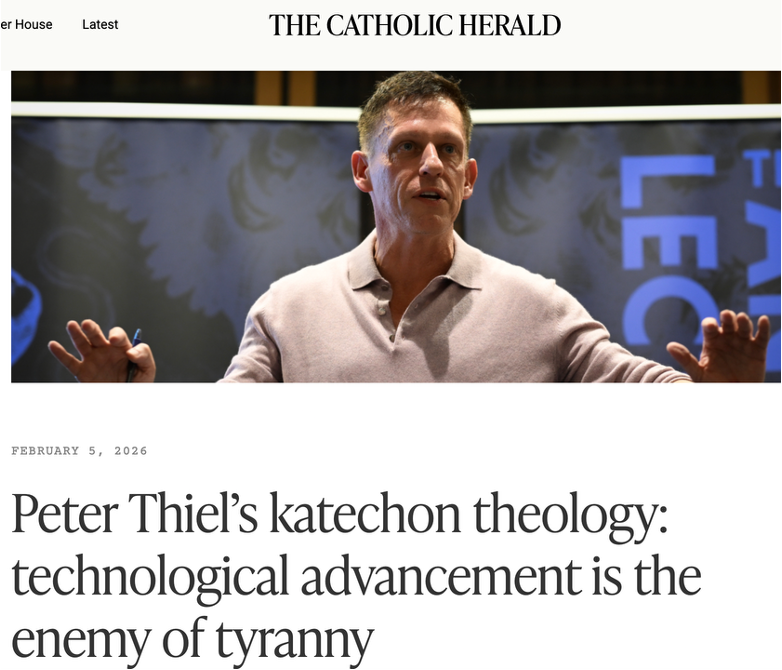
The case being made by Thiel and Wolfe is a case for open competition. “Antichrist” appears as He Who Monopolizes so as to arrest progress, or as He Who Arrests Progress so as to monopolize. They press this case by asking a follow-up question: “One world or none?”
Men fear that warring powers, with the new arsenal of weapons becoming available, will lead us all to total destruction. The instinct for self-preservation supplies a natural bias towards one world, rather than none. It pushes us to welcome Antichrist, however reluctantly, as a political exigency—to see the need for world government if there is to be any prospect of peace and safety. But Thiel and Wolfe suggest that we should not give up so easily on our liberties. The tech bro, if cut some slack himself, can help restrain Antichrist.
Philosophically, we might say, this is the ancient problem of the one and the many. Politically, it is the problem of maintaining order without altogether eliminating choice. Economically, it is the problem of stagnation versus progress. Theologically, as Bacon knew, it is the problem of distinguishing between divine and human providence.
Thiel and Wolfe traverse these several dimensions, passing imperceptibly from one to the other, to arrive at a creative solution. Drawing on the authors mentioned, they employ Christian symbolism to help them reformulate the dilemma “One world or none?” as “Antichrist or Armageddon?” Then they suggest that the Christian can escape its horns by saying a firm No to both, praying instead for “new miracles, new technologies, and strange new possibilities.” That way he himself becomes a kind of katechon.
As they put it in their most recent article, the Christian must “recover faith in the future.” It is urgent that he do so, if he means to resist Antichrist, who stands ready to strike. He must side with the entrepreneur who will keep technology moving too quickly for hegemonic One World forces to capture and tether. Thus will human reason yet prove, in Bacon’s famous phrase, “a rich storehouse for the glory of the Creator and the relief of man’s estate” without relieving man of his estate; that is, of his liberty and capacity to innovate.
Now, I have innovated a little by putting it thus, but I think I’m on the right track. The details remain somewhat murky. Thiel apparently wants to help one hegemon, America, restrain another, China, even at the risk of the former becoming more like the latter, so long as entrepreneurial freedom can be maintained. We may well wonder how that will turn out. Are we not already witnessing the Sinicization of the West, aided and abetted by its wealthiest entrepreneurs? Are they not big on biometrics, surveillance, data control, narrative spinning, boundary making (creating personal fiefdoms) and boundary blurring (benefiting from public/private partnerships)?
The neo-feudalism of our capitalist tech lords, with their private cities and unregulated experiments in bio-hacking, has not gone unnoticed. They claim to have moved on from the Enlightenment and from liberal democracy. They state quite openly their intention to move on from nature itself. They promise to make life Edenic, and death optional. All of which which sounds rather like relieving man of his estate. What else will they relieve him of in the meantime? Will the ordinary man, who will no longer be a working man but a fully dependent man, be able to compete with them for his own space and way of life?
A dialectic of subsidiarity and solidarity can serve to keep society consensual rather than coercive, or so a Catholic would say. But can a dialectic of deregulation for the sake of unfettered technological advance, and of total surveillance by data-hungry companies such as Palantir, do the same? Hegemons are, after all, hegemonic. What needs to be restrained is not mere hegemonic power, but the lust for power and the anomie on which it feeds.
That is a spiritual and moral challenge, before it is a technological challenge.2 Are the tech bros equipped for it? They don’t even know that “it is appointed unto man once to die and, after that, the judgment.” Or perhaps they do know, and are desperate to escape the judgment. In any case, the engines of their new Eden must be fueled, at nature’s expense. The secrets they yield must be carefully guarded, for the sake of profit if not of prudence. And the diktats flowing from the guardians will have to be faithfully obeyed, if disorder is not to prevail. All very N.I.C.E. in principle, is it not?3

Things are already murky in The New Atlantis, that posthumously published utopic vision that is the first stop in “Voyages.” Bacon describes a remote island the inhabitants of which are engaged, with the benefit of ancient wisdom, in a well ordered pursuit of scientific and technological advance. Yet his description is replete with coded warnings about its antichristic potential, as Thiel and Wolfe notice. While their decoding is unreliable, and their estimation of Bacon as a “closet atheist” with antichristic sympathies highly debatable—more debatable, perhaps, than in their own case—they are quite right to highlight this feature of the work.4
They are also right to argue that the solution is not fear of experimentation and innovation, which are proper to man’s estate, but rather prudence in the practice thereof. But whose prudence? A prudence based on what? Who is convinced of the prudence of our tech bros, who are by no means convinced of each other’s prudence? Thiel at least gives the impression of desiring prudence, and the wisdom on which it must be based. But he moves far too quickly to be a reliable guide. Perhaps that is because he lacks Bacon’s sense—a still biblical sense—of man’s fallenness, and the realism that sense requires and affords. In Bacon things are not altogether murky.5
The Wisdom of Solomon
Bacon breaks off his tale in The New Atlantis after a detailed account of Bensalem’s most important institution: Salomon’s House, or the College of the Six Days Works, the end or object of which “is the knowledge of causes, and secret motions of things; and the enlarging of the bounds of human empire, to the effecting of all things possible.”
The rehearsal of its works, delivered to the narrator straight from the royal mouth, is to be shared as a sort of gospel “for the good of other nations,” which do not live, as the inhabitants of Bensalem live, “in God’s bosom.” Those who will carry it to the nations are commissioned, in the person of the narrator, with a priestly blessing from the royal personage, and financed by a bounty of some two thousand ducats. “For they give great largesses where they come upon all occasions.”
That’s it. There endeth the lesson, with that ambiguous sentence, a sentence that can certainly be read in quite different ways.6 But then follows, in brackets, one further enigmatic line, set off by itself: “The rest was not perfected.”
What does that signal? That there is wanting, as yet, an Acts of the Apostles to complete this Gospel of Bensalem? Or rather that, when it is written, it will be seen that man, for all his noblest efforts, is incapable of perfecting very much, and that he remains insecure even in what he does perfect? What, after all, became of Solomon the Wise? He was seduced by his own success and “did what was evil in the sight of the LORD,” who became angry with him and caused his marvelous empire to collapse.
The College of the Six Days Works notwithstanding, even the Bensalemites are deceived if they think that they dwell in the bosom of God and can attain to the divine rest by their own labours.7 The man aspiring to that rest, as Solomon (if we may take a hopeful hint from the conclusion to Ecclesiastes) at last learned, must remember the Sabbath Day, to keep it holy, and obey all the other commandments of God. “This is the whole duty of man. For God will bring every deed into judgment, with every secret thing, whether good or evil.”
But now you will think that I am trying to defend Bacon from charges of being a closet atheist with antichristic sympathies. A defence can be mounted, but that is not my purpose. My purpose is to advise the tour guide to slow down and take more care. Deploying Christian symbols to express a thought does not make the thought Christian. Referencing Paul’s katechon does not make one’s own katechon Pauline. Talk of antichrists does not make one’s scheme Johannine, though it might make one a Joachimite.8 Fascination with Tolkien does not mean that one thinks like Gandalf the White rather than like Saruman of Many Colours.
A False Dilemma
I also want to point out to the whole tour group that the dilemma—“One world or none, Antichrist or Armageddon?”—is not a biblical dilemma. That question is not one Paul or John would think it sensible to ask. Its answer cannot be “neither,” but only “both.” Armageddon is Antichrist’s doing and Antichrist’s fate.
So our guides have not got us off to a good start. While it is doubtless true that science and technology can be made to serve Antichrist or in some way to hinder Antichrist, science and technology can neither summon nor restrain Antichrist unless both Christ and Antichrist are functions of science and technology. Which they are not.
At the very beginning of The New Atlantis, Bacon puts in the mouth of “a man of pleasing countenance” the question, “Are ye Christians?” That is a question one can imagine Paul himself putting, though he was not of pleasing countenance. Indeed, it is a question he is always putting, which has the effect of rendering him still less pleasing to some. Since Thiel and Wolfe put it to Bacon, I will now put it to them. Why do they show no interest in Jesus Christ? Why do they evince no love of his appearing?
Indeed, on their scheme of things it seems that “Christ,” like Armageddon, stands for chaos and destruction while “Antichrist” stands for hegemonic order. Both, they contend, must be kept at bay. And who or what will do that? The katechon of entrepreneurial freedom, for which Thiel and Wolfe are apostles—apostles to the Christians, equipped with a purse full of ducats to support their itinerary, even as far as Rome.
© D. B. Farrow 2026
Read Part 2
Schmitt’s abandonment of the Catholic Church was connected to the fact that he had absolutely no self-restraint, sexually, and did not wish to be restrained by the church. That is not a rare phenomenon, though his own case was rather rare.
On the technological side, things are going swimmingly. Thiel’s Palantir, like a great Leviathan, is swallowing up enormous amounts of public and private data, including, for example, the daily operations of policing. I had this confirmed to me recently by a policeman friend of mine, who is rightly wondering about the loss of confidentiality and of human discretion in his chosen profession.
I refer, of course, to C. S. Lewis’s fictional National Institute for Co-ordinated Experiments in That Hideous Strength, a novel in which the hero, Ransom, functions (with help from the Oyarsa of Mars) as a restrainer.
But what are they doing importing back into The New Atlantis (1627), from Solovyov’s “Short Tale of Antichrist” (1900), an analogue of the latter’s plot twist in which “the Jews, who regarded the Emperor as a true and perfect Israelite by blood, unexpectedly discovered that he was not even circumcised”? That passage came to mind when I saw them embellish Bacon’s description of the mysterious Joabin as “a Jew and circumcised” by adding that the circumcision was “discovered under circumstances too scandalous to print,” so as to attribute to Joabin, two traditional antichristic features, “being Jewish and gay.” Is this coding gone rogue, or a form of black humour that plays on circumstances in Thiel’s own life too scandalous to print?
In an essay she entitles, “If Scientists were Angels,” Louise Liebeskind argues quite persuasively that Bacon was warning modern man that the new marriage of reason to empiricism was fraught with various dangers against which the wise must take what measures are possible. She suggests that his approach was one that took human fallenness seriously, without taking too seriously the credal beliefs in which that notion had been couched. Todd Daly, in “‘Relief of Man’s Estate’: The Theological Origins of the Modern Biomedical Project,” also stresses Bacon’s attention to fallenness, but finds in him not a general skepticism about theology so much as a particular deficiency in christology. In Thiel, I would say, there is a deficit in both departments.
Is there an allusion to Psalm 26:10, that is, “to men in whose hands are evil devices, and whose right hands are full of bribes”? There are definitely allusions in the preceding lines to the opening chapters of Genesis, the prologue of John, and the Great Commission in Matthew 28 and Luke 24. To what end is a subject of much debate, but at the outset of Valerius Terminus, as Daly reminds us, Bacon calls for reason within the bounds of religion; not, as Kant would later enjoin, religion within the bounds of reason. Just as Thomas More’s Utopia must be read in light of More’s theology, not against it, so also The New Atlantis requires the light of Bacon’s theology.
Cf. John 1:18 and Romans 10:6–9.
Joachim of Fiore was an insatiable interpreter of scripture, but not a reliable one; nor are Thiel and Wolfe reliable interpreters of Joachim, in whom they dabble in the second article. Joachim, as Lessing argued, lies somewhere near the roots of modernity, and, as I have argued myself, of its mistaken notion of progress.
I’m looking forward to the next instalment. I think it’s worth mentioning that it came up recently in a group discussion an argument that Jordan Peterson made trying to explain Judas’ betrayal as ‘suicidal empathy’-driven (or something to that effect.) Therefore, I will be quoting you tomorrow when our group meets again, namely: “Deploying Christian symbols to express a thought does not make the thought Christian.” Thanks for that!